Wednesday, June 30, 2010

The fabulous lunch that almost killed us

Our most excellent hosts at AMIDEAST booked lunch today at The Seven Seas. It is a beautiful restaurant that sits right on the edge of Gulf with a beautiful view of the city scape and the sea. It was elegant and beautiful. There was the minor detail that it was also a popular place to smoke shisha, but we sat as far from the smoke as we could. We sat down to the prix fixe menu, so we didn't know what would happen. First came this plate:

Was it our salad? It looked pretty chunky, but just as we were about to attack it, the appetizers began to come out. It turns out that was the center piece that we almost ate. Well, the food kept coming and coming and coming. It wouldn't stop!

Finally, we sat back and sighed. We had done it: we had met the lunch and ate it. But wait! Four trays of dessert suddenly appeared on the table along with Turkish coffee so thick you could stand a spoon up in it. Here are two of the four dessert trays.

Holy Smokes! We did our best. It was all so good, and there was so much of it. We waddled out of the restaurant vowing never to eat again as it seemed we had reached the pinnacle of quality and quantity.

A little more on journalism

************
please note: this post does not intend to criticize the government, the emir, or Kuwaiti culture. This post includes only observations made directly from published newspapers freely available in Kuwait and interviews with Kuwaiti journalists.
************

In reading the local Gulf newspapers, it is clear that local journalism is still developing its own distinctive voice. Sometimes an article will mention a topic in a headline that has already efficiently summarized the content of the article. For example, an article with the headine "38 Individuals take pre-marriage test" reports that 38 individuals took a pre-marriage test and were happy with the process.

The daily paper I prefer to read, Al Watan, often includes some very entertaining sentences at many linguistic levels. Here is an example from the opinion page: Islam is particularly concerned with alcohol and its strict prohibition stems from the fact that not only does it affect the mind, but also it influences the spirit of its consumers in a sense that in both cases alcohol consumers have no power and control over their behavior as well as their utterances.

However, in addition to the linguistic interest of these periodicals, there is also an interesting process of content selection. By general consent, one does not criticize the ruling family, although the constitution only specifies that one cannot criticize the emir. Of course, this is unless they shoot each other, and then the papers will report that as they did last week when a nephew shot his uncle outside a diwaniyya. This caution was repeated in many conversations throughout the Gulf. A journalist we spoke to said, "There is no censorship. We are free to write about anything we want. We just don't criticize our advertisers because the paper needs them." So, no criticism of the ruling family, the emir, or the advertisers. As a result, the Kuwaiti parliament is eagerly covered by Kuwaiti journalists. For example, "In the meantime, the parliament approved amendments to the foreigners law, whereby the offspring of Kuwaiti women married to non-Kuwaitis will be exempted from residency fees. These women have been also entitled to sponsor their non-Kuwaiti husbands, while their children will be entitled to permanent residency provided the woman was not naturalized by marriage in accordance with article 8 of Citizenship Law."

Yesterday, we met with four journalists from four of the local papers. We were very excited about the prospect of speaking with them, and at breakfast we planned what questions we might expect from them and how we might respond. When we arrived and sat down, they asked two questions: What do you think of women's situations in Kuwait? and How have the financial difficulties of the economy affect the Fulbright program? Then silence fell, and there was a long, awkward pause. Finally, one of the journalists asked, "Do do you have any questions for us?"

I asked, "Could you talk about the educational path that lead you to journalism?"

One young man responded, "Well, I have a degree in economics, but this job was available, and I kind of like it."

Another slightly older man said, "I have 15 years experience in hospitality management, but there was no work in that field for me, so I am doing this." Clearly the papers must have kept back their trained journalists for real stories.

So, even though the job of journalist does not seem to be at the top of the Best Employment list, they are quite creative. Here are some of my favorite headlines from the past few days.

"Young Kuwaitis Seen Exercising Tuesday morning"
"Healthy Citizens Warned Against Pretending to Be Handicapped"
"Encouraging Female Ex-Patriates to Breastfeed Citizens"

Tuesday, June 29, 2010

The continued development of writing

I'm just saying.....

Today Al Watan reported that a blogger in Egypt had been pulled from an internet cafe last week and beaten to death by police in the street outside. The police report that he died from asphyxiation as a result of swallowing a bag of heroin just as police entered the cafe. The family dispute this finding.

Today Al Watan reported that four Jordanians have been arrested for postings on Facebook that were deemed slanderous of the government. The postings were not reported.

Today the Kuwait Times reported that a blogger who criticized the Emir was let out of jail on bail because of poor health.

In other news, the Rolling Stone has suddenly developed a journalistic reputation in reporting that some members of the military may not hold the highest regard for the present administration. As a result, the Rolling Stone reporter has kept his job, but McChrystal and his civilian press aid has lost theirs.

Sunday, June 27, 2010

Role Ambiguity at the Souk Almubarkiya

A few evenings ago, Beth, Jill, and I (all ladies of a certain age), when to shop around the Souk Almubarkiya. This is a huge souk. It is a maze of little shops chock full of *everything*. My inner crow was in heaven. There were piles of copper coffee pots, stacks of different types of rope, heaps of suitcases, racks of abayas and dishtasha (with accompanying underwear), poles of prayer beads, and masses of scarves. And so much more, all piled up and tended by enthusiastic men, and occasionally women, who would call to us as we passed, "Welcome Madame" or "Please Madam" or "Here Madam". We stood out as "not from around here" as we strolled through this garden of material culture. Men with trays of fruit drinks cruised the alleys in case anyone got thirsty. Once we got lost and wandered through a men's coffee area. That was awkward.

However, Debra and I went back the next day. Debra wanted to get an abaya and a sheyla, and I went along for company. However, I was made uncomfortable by the content Madaming, so I put on a sheyla to try to hide, after a fashion. It totally worked. Nobody Madamed me. When I stopped to look at something, nobody came over to pressure a sale. It was much more comfortable to shop this way.

Well, Debra went into one corner to purchase an abaya, and I was helping out. I held her bags (if you know me, you know I was totally "hands free" myself), and I offered helpful advice. I held her skirt down as she tried on abayas so there would not be some kind of inappropriate show. After she made her purchase and was ferreting in her wallet for cash, the shop keeper folded up her purchase, put them in a bag, and briskly handed me the bag with a curt, "For Madam." As we walked away, I puzzled a bit about about that interaction, and it occurred to me that he must have thought I was her maid! It was hilarious. Here is my photo of me being Debra's maid. I guess that's why nobody bothered me at the souk. I didn't look like I had any money to spend. Here is the photo Debra took of me in my role as her maid.

Museums in Kuwait

For many interesting reasons the arts have an ambiguous place in Kuwait. There are lots of museums, and I think we have visited them all! We went to the Dickson House where the most famous British Colonial Administrator and his wife lived in the early 20th century. Violet Dickson, the lady of the house, was quite the formidable character. There is a story told about her that when she and her husband moved in to the traditional sea front house they were to live in for their entire tenure in Kuwait, she had a bit of house cleaning to do. Evidently, the place had gone to ruin under the auspices of the previous colonial administrator, and the place was full of rats. One night Mrs. Dickson put out a white sheet in the courtyard, put food on it, and waited. As the rats came out to eat the food, she shot them one by one with a rifle. So much for the rat problem. Here is a photo of Mrs. Dickson in the desert with her son. In Arabic, the mother is referred to as "Mother of [son's name] so since her son's name was Saud, in this photo she is identified as Umm Saud.

We also went to the Sadu museum. This is the traditional Bedouin weaving museum. It was full of lovely weavings. While we were there, a group of chatty young girls came in to have their weaving lesson, and they seemed very excited about it!


We went to the national museum in a tremendous dust storm. It was eerie to walk around the windy, dusty abandoned courtyard. The national museum had some fairly unlabeled faintly organized archeological exhibits from digs on Failaka Island which dated back to 3,000 BC. Evidently there was water on this island and it was a verdant lovely place to live and trade with local boat traffic. That was until the Iraqi invasion when everybody was moved off the island and the beaches were mined. Now there is a small beach resort and strange heritage village on the island, but the town is a ghost town. More on Failaka in another post.

The national museum also houses a "heritage village" that is a warren of little alleys to emulate a souk with little stalls inhabited by mannikins in awkward ethic craft poses. This is followed by an eclectic collection of artifacts from the 20th century like a bunch of stringed instruments, many typewriters, some bakelite telephones, and lots of coffee pots. I had heard that in the invasion, the Iraqis had looted the museum but by now 90% of the original catalog had been returned. However, these artifacts must have been on loan somewhere because we did not see anything that looked like it might have warranted looting.

We also visited the planetarium at the national museum. We asked for the English language galaxies show, which was really cool as it showed excellent pictures from the Hubble telescope. However, if I may nitpick a bit, the cheesy introduction suggested that the history of astronomy began with the European renaissance, and I happen to know that Galileo et al were all reading the works of astronomers from this part of the world to inform their work. In fact, Galileo wrote in Arabic script. In the Sharja museum in the UAE, there is an extensive astronomical technology exhibit from well before the European Renaissance. I found it odd that the Smithsonian Institute, who claimed to have made this planetarium show, did not know about the Arab astronomers.

We also visited the Museum of National Memoriam which documents the Iraqi invasion. It is principally dioramas that re-enact the progression and atrocities of the invasion of 1990. It was quite traumatic, not just to learn about the minutia of the atrocities but to be assaulted by the very loud simulated air raid, machine gun, tank, and screaming sounds that went with each installation. After the dioramas came the individual memoria to the people who died or were POWs. It was heart wrenching to view the pictures. I asked several young people we met if they had gone, and they said, all their schools had taken them there as a field trip, but many said they did not really pay a lot of attention: they remembered it was loud and dark, and one young lady said, very softly, "It made me hate Iraq."

On a less traumatic note, we visited the Tareq Rajab Museum. This is a private home made into a museum for the private collection of Tareq Rajab. He was the first director of the Department of Antiquities in Kuwait and was an avid collector. The museum has a large collection organized according to the 19th century British catalog system: put things with the same shape together in the same place. It is a varied and lovely collection almost entirely unencumbered by text. The silver jewelry is lovely, the collection of ornamented flintlock rifles is astounding, and the traditional costumes are beautiful. They have a whole section devoted to the country of Palestine.

The most exquisite of the museums was the calligraphy museum. It had a riveting video about how to make the ink and reed pens. The pieces were so beautiful that I was re-inspired to continue my Arabic studies. There was also a collection of Arabic calligraphy done by a Chinese artist.

But what about modern art? Is there any in Kuwait, or is it all just heritage crafts, and with modernity art died in Kuwait? Mais non! We visited the modern art museum, much to the surprise of the single docent. Much of the modern art displayed in the museum seemed to date to the 70s and 80s, but there were some 21st century pieces there also. I thought the most striking pieces seemed to come from the sculptors who were responding Kuwait's struggle to find itself in the 80s and recover itself in the 90s. This was the most evocative piece for me by the artist Sami Mohammed, dated 1989.

So yes, Kuwait has local art, and there is community involvement. It is not very well advertised, but it is there, and it is all worth going to see. The Amideast organizers have done a great job organizing all these visits, and I have learned so much at each one.

Saturday, June 26, 2010

A piece of satire: Dusk in Araby

Dusk in Araby
by Ruth Benander and Debra Beilke
----------------------------------
Authors' Note: This piece is intended as satire. No disrespect is intended towards the Fulbright-Hays Program, The American University of Kuwait, Kuwait City, the Dubai Police force, or the Ghani Palace. This piece of satire does not intend to minimize in any way the crime of human trafficking.
----------------------------------

The Ghani Palace Hotel crouched on the shores of the Arabian gulf, her faded glory gently decaying into the desert.  Once she may have been considered lovely, but her charm had gone grey, and the process had not been graceful.  In her later years, she received few guests into the warrens of her hallways, and when she did, it seemed to come as a great surprise.  As her splendor waned, she became more of an architectural bookmark for beach front property rather than a page of text for some form of holiday nostalgia.  Foot steps in her halls and many stairwells raised dust and sent the staff into a panic.  But her bulky shadow could hide money as well as dust, and in the freewheeling blackmarket of the Gulf, this made her attractive.  

Despite the mosque-studded skyline, the Kuwait City of the Ghani Palace, its own parallel universe, teemed with vice of all kinds—opium dens, beer-induced belching contests, and ladies’ saloons, to name some of the more rampant examples of sin in this den of iniquity.   Yet lurking even deeper beneath the surface was something worse, far worse—an international ring of academic human trafficking known to insiders by the code name Fulbright-Hays.   The latest crop of FH captives were trapped in a dhow that had been anchored close to the shoreline for weeks since they could not confirm their booking at the Ghani Palace.
 
Undercover agents from the Dubai police department were appalled at the human misery they discovered (via hidden video cameras rigged to the dhow’s interior.)  The middle-aged captives were rolling in agony on the deck of the dhow as it rolled back and forth, back and forth, back and forth in the waves and the 120 degree heat.  Already miserable from sea-sickness, the hapless academics were tortured even further by the techno-funky rap music pounding so loudly the reverberations were felt in Baghdad.  Although the Dubai police (henceforth known as the “Dubai Boys”) felt the pain of the FH captives, they did not rescue them—not yet.  They needed to watch and wait in order to uncover enough evidence to convict the king pin of this human trafficking.  Daily, the Dubai Boys were learning more and more about this powerful Godfather.  They knew he was headquartered in Washington, D.C.  They knew his name was Joey.  They knew his days were numbered.

It was noon in DC, seven in Kuwait, and Jerry was worried. The men holding the academics reported that yet another academic had requested to move to another location on the dhow, and several were complaining that the internet connection on the dhow was slow. Three had begun to clean the dhow, much to the dismay of their captors. This was not how humans being trafficked were supposed to behave. Worse yet, they were all taking notes and competing to interview their captors, each crafting clever questions to expose their captors' world views and cultural identities. Joey knew things were going from bad to worse when he discovered that the academics were blogging about their unique perspectives on the nature of human trafficking through ethnographic explorations and chronicling the disorienting dilemma of such participation. They drove their captors crazy by constantly trying to critically reflect on their experience. Joey knew he had to pawn them off soon on some university looking to contract faculty to teach English as a second language for low wages. How else could the knowledge economy be supported except through cheap academic labor to construct the foundations for the best educated populations in the world? It was dirty work, but someone had to do it. Joey just saw himself as another epistemological middleman. He contacted his man, Jamal, in Kuwait.

Jamal sat on the roof of the Ghani Palace watching the sun set over the broiling city, throwing cigarette butts into the roof-top pool. He fondled his prayer beads as he reflected on the Fulbright Hays dilemma.  Clearly, something had to change; the dhow was no longer a safe place to keep his captives.  But where to transfer them?  As the hot desert winds began to whip themselves into a frenzied sand storm, Jamal had a brainstorm.  Why not move his human cargo to the Ghani Palace?   Nobody would ever think to check for them in the Palace.  It never occurred to anybody to check into the Palace.  It was the perfect solution.  There were a few minor problems--such as the need to train his operatives how to put towels in the hotel rooms, how to clean the sinks, how not to look confused when a hotel guest tried to check in—but these could be easily resolved.
  
Two hours later, Jamal was riding the waves of the Arabian Gulf on his jet ski as he raced towards the dhow at full speed. He was followed by a twelve-pack of Filipina operatives in matching outfits on their own jet skis.  He was feeling good, full of resolve.  He and his operatives would climb on board stealthily and grab the captives from behind.  Before they transferred them to the jet skis, the Filipinas would, of course, offer them coffee and a selection of chocolates.  Working in the underbelly of academic trafficking is no excuse to behave like barbarians, after all, and protocol had to be observed. 

Suddenly, in the dark and stormy dusk, a door slammed, a maid screamed, a pirate ship appeared on the horizon. The maids scattered in confusion, their jet skis making a maze of wakes that shook the dhow like a flag in the stiff breeze. Jamal leapt from his jet ski to the dhow, desperately clambering up the ladder, slick with the two-stroke engine sheen left by the hordes of jet skis. He was unprepared for the sight that met his eyes. The dhow had been transformed into faculty offices. Surrounded by reference texts, maps, and jumbles of flash drives, the academics looked up.

"Do you have any cold water?" one asked distractedly, "It's rather hot. How can I be expected to complete my curriculum project if there isn't a cold bottle of water to drip all over my notes?"

                “I’d rather have a beer,” muttered one under his breath.  “When I was trafficked in Ghana, at least they had plenty of good beer.”

                From a heap of books and papers, another academic peered at Jamal and asked, "Where are your parents from? Do you have national rights? Did you go to university in the United States? How do you feel about the efficacy of the parliamentary system in a country where family clan loyalty is still an entrenched decision making protocol? "  

                A third academic marched briskly up to him and said, "Your maps are out of date. You only have maps from the 1940s. Have you noticed that things have changed? You can't still list pearl diving sites in maps of the 21st century because that is merely a rhetorical invocation of the past. There is no place for rhetoric on maps."  She glared at a stunned Jamal. 

                Yet another captive, who lay groaning with sea-sickness, mewed feebly from across the dhow, “Do you know of ANY Kuwaiti authors?  Any at all?  There must be at least one Kuwaiti Jane Austen wannabe…”

                A distinguished academic in the back shouted, "This hummus is terrible!  Give me a proper kitchen and I'll make you hummus that will knock your eyes out."

                Jamal sat down. Who were these people?  He was promised young pretty girls with pert American accents. It was supposed to be easy: take their passports, promise them authentic exotic experiences, and hand them over to the American University.  This crop of contract workers did not look at all like pretty young girls and taking their passports appeared to be as easy as finding edible food at the breakfast buffet of the Ghani Palace.  "I have to think," Jamal said, voicing his confusion aloud. The result was immediate. All the academics retreated to their piles of notes and left him alone.  Someone had to think: they understood that. 

                Jamal looked disconsolately, and then with growing hope, at the approaching pirate ship which appeared to have Dubai Police stenciled on the side.   Yes, he was correct:  it WAS the Dubai Police, those high-tech superheroes of justice who were so effective at stomping out crime in their own emirate that they had been recruited to clean up in Kuwait as well.  Jamal knew that the Dubai surveillance apparatus was second to none.  He knew, too, that their gig was up.  They were busted.  What to do?  He made his decision:  he would give himself up to the Dubai boys and tell them all he knew about Jerry.  He hoped they would be lenient on him.  After all, he was just a low-paid contract worker himself.  Why should he go down for the Godfather’s wrongdoings?  If he were lucky, he might get off with 100 lashes and deportation to Egypt. 

            He stood up on the front deck of the dhow and waved a white flag at the Dubai Boys. From the bow he had a better view of the approaching ship. The Dubai Boys had spared no expense. The finest calligraphers in the world had stenciled the gleaming white cutter, the whitest in the world. The cabin towered above the deck and was the tallest cruiser cabin in the world. And what was that tall white structure in the back? It looked like a ski slope….it WAS a ski slope—the tallest manmade pirate ship ski slope in the world. Those Dubai boys knew how to travel in style. Unfortunately, the entire boat was not occupied, as several cabins remained empty since the construction of the boat. The interior was not quite finished, but none of that mattered: from the deck of the dhow, they looked good. The best in the world.

As the Dubai Boys pulled alongside the dhow, Jamal had second thoughts. He figured it might be better just to lie low. His English was good, he was wearing cargo shorts, and if he could just get his hands on bulky man-bag, he might be able to pass for a professor. Quickly, he huddled behind a nearby stack of papers and tried to look interested in minutia.

The police were getting busy. It took some time to rescue the academics. As soon as the Dubai Boys thought they had them all in one place, two or three would wander off. One kept requesting coffee. Another briskly informed the police that it was time to pee, and half the group disappeared into the bathroom. In a desperate attempt to get the academics off the dhow, an officer announced that there would be coffee and snacks served on the other boat. The effect was electric; most of the academic, now plus Jamal, were on the police cruiser so fast the dhow hardly rocked, but on the way over two of the academics got distracted and leapt overboard. Fearing some kind of bizarre escape from rescue, the Dubai Boys looked over the railing. There were two middle aged ladies paddling around next to the boat.

“Look at us swimming!” they called, “Does any one have a camera to document us swimming in the Gulf!”

The Dubai Boys pulled them out and firmly locked them in the cabin to drip all over the sofas and not create more distractions while Jamal clutched his makeshift man-bag to his chest and hoped he would not be noticed. The Dubai Boys did not have time for details like counting human trafficking victims. Since there was no human trafficking in Dubai, they actually had little experience with the crime. Only 23 cases were recorded each year in Dubai! As a result, they figured they would just liberate the academics in Kuwait City and let them figure out the details. Jamal had no cause to worry. Maybe, he thought, this was his ticket out of the Ghani Palace and on to better things. He planned his new future during the trip back to shore.

On shore, a new crisis presented itself: where to put the academics? The Dubai Police were not interested in some measly victims of human trafficking. Who could believe them anyway: they probably came to work as contract educators for the universities on their own, planned a dhow trip, and got stuck out there. And lost their passports. And had unrealistic expectations about their work situation. They probably brought it on themselves. The Dubai Police were more interested in the mysterious Joey. The academics could tell them nothing except that he had booked them rooms at the Ghani Palace Hotel. If the Dubai Police couldn’t get a lead on Joey, they at least discovered a block of rooms reserved and paid for at the Ghani Palace. But there were only rooms for ten and there appeared to be eleven in the group. Jamal tried to make himself look smaller and more erudite.

“Make the guys room mates,” barked the Dubai Police sergeant in a sudden fit of inspiration, and the confused desk clerk tried to figure out how he would give the guys rebates, as the sergeant requested. The desk clerk was better at intimidating young women than booking guests into a hotel. These were two completely different skill sets. He knew guests needed keys, so he just started handing out keys. It worked: they all went away. The academics, the police, the guys from the pool hall down stairs who had come to watch the show: they all went away. A dusty calm resettled on the reception area of the hotel. The desk clerk went out to give tuna to the stray cats, so he did not hear the phone begin to ring as the new guests he had given room keys to discovered that they were living in a building whose maintenance had been neglected and this neglect needed to be instantly reported, noted, addressed, and critiqued.

Jamal went back up to the rooftop pool to smoke. He was back where he had started, but he felt changed. He had narrowly escaped, and it seemed that Joey was incommunicado. What to do? He had rather liked the eccentric tribe of the professoriate. They were geeky but fun. He liked his man-bag. It was so much easier than carrying everything in his pockets, and there was room for water and a hat. He contemplatively flicked another cigarette butt into the pool and wondered if he were too old for graduate school.

Wednesday, June 23, 2010

The Veil as Red Herring


Much is being made of veils/hijab/hegab etc. In the newspaper yesterday, it was reported in one country that wearing veils for women was just made compulsory: there was an outcry of protest. (Somalia just made beards and mustaches compulsory for men). In an article right underneath the one about compulsory veils for women was one where the man in charge had just ruled that veils were illegal: there was an outcry of protest. In a recent documentary on Egypt, the women interviewed had many different reasons for wanting or not wanting to wear the veil, and another documentary on Muslims in Michigan interviewed women who were talking about their personal choice to wear the veil. Interestingly, when one consults the Qur'an on this topic, there are only verses that refer to modest dress for both men and women, but none specify wearing a veil as a requirement for Muslim practice. When asked some local Kuwaiti women about this, they laughed and said, "It is about cultural identity. It is the way of our people." One woman made the personal observation that when a Qatari woman wore her veil pinned tight, it was for religious reasons, and when it was loose and required constant elegant adjusting, it was a cultural identity item.

Legislating costume is always difficult, and it seems that the "reasonable person" criteria often takes care of "decent dress". Of course one can still be utterly scandalized: I don't understand the increasing cleavage exposure in Ohio. But back to the Arabian Gulf: the veil seems to be about choice. An elegant, time consuming fashion choice at that! Modesty? Heavens to Betsy: some of the veils and abayas (and concomitant shoes) in the Arabian Gulf are anything but modest in their fancy cut, elaborate decoration, and extreme fashionistaness. So for people to get all bent out of shape about whether one wears a veil or not is a distraction from other topics of more pitch and merit. The more important issues involve women's participation in public life, education, and social institutions, not what they wear when they are doing it.

For example, in the Kuwaiti parliament, here are two members of parliament, equally dedicated and effective in their work. One wears hijab, the other doesn't. When I went to visit a girl's school recently, it made more sense to choose to wear a more conservative style of dress. Certainly when visiting the mosques, one dresses according to tradition, but putting a scarf on my head does not muffle my brain. There are other issues that muffle the brain, like having one's father or older brother have the last word on whether one goes on to higher education or not, or not being able to travel without male sponsorship.

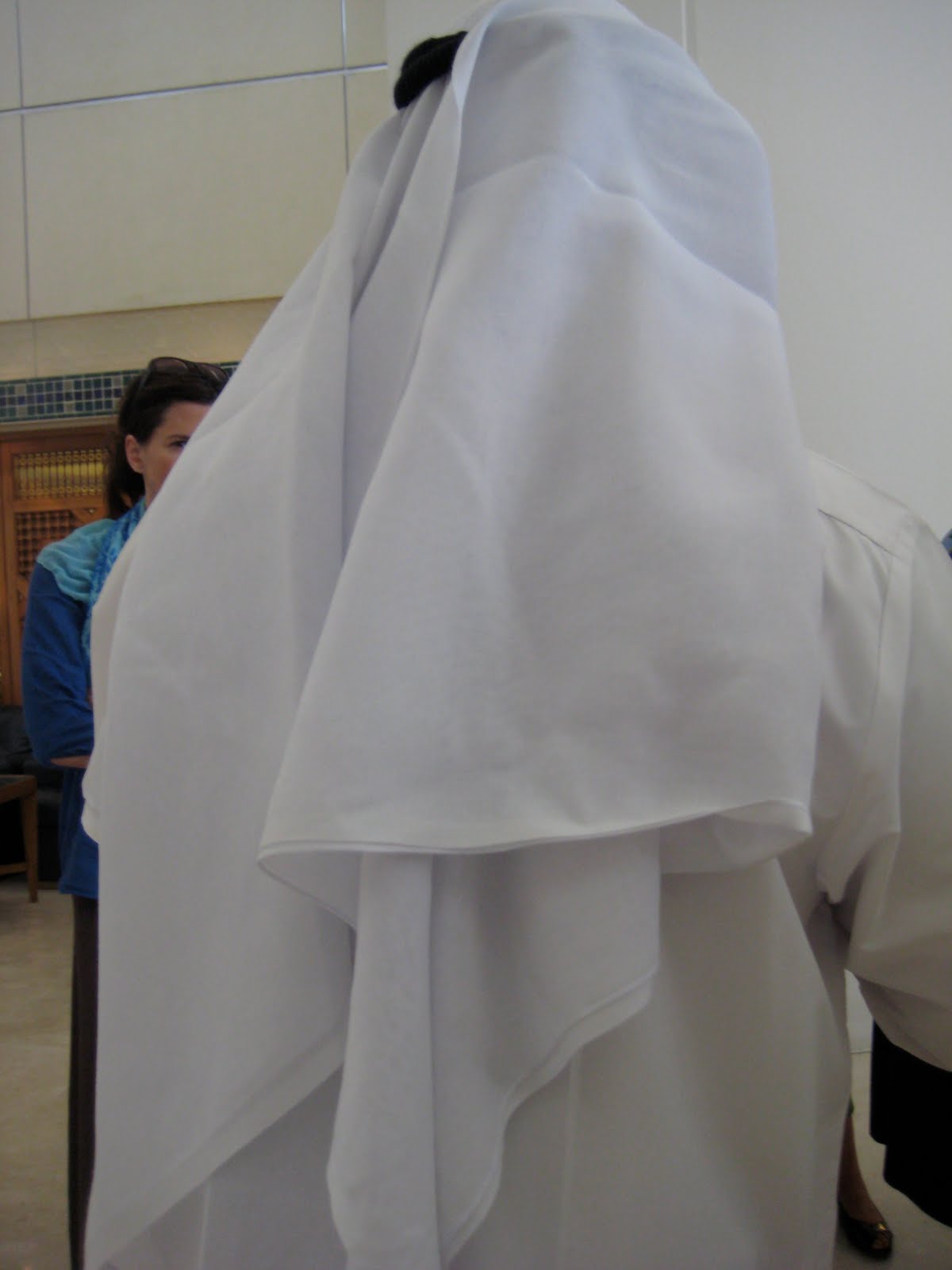
I am also very interested in the fact that men's veils are not addressed with the same fervor as women's veils. These guys arrange and rearrange their veils with the same fashion sense the women do, but they are not required in the mosque the way women's head coverings are. As long as the head covering is a choice, then letting people choose does not seem to hurt anybody, but when it becomes external legislation, then there are problems. It will be interesting to see how the Somalia issue plays out where men's facial hair is now legislated.

The one thing I have issues with is the niqab, the face covering. To me, a western person in whose culture honesty is a value equated with seeing a person's face and where masks are seen as inherently duplicitous, the niqab has the cultural feel of a mask. I still find it a bit of an adjustment to have a conversation with a person who is wearing niqab. I can get over it, but at first it is like "don't stare at the niqab: oops, staring at the niqab".