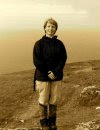
Our department is currently creating bios for our website. As you know, Gentle Reader, audience and purpose are very important in crafting a piece of writing. Here is what I originally wrote thinking of the audience of potential students with the purpose of inviting them to join our club. However, I had misjudged both audience and purpose, so I had to revise, which I was happy to do. Here is the version with the new audience and purpose: Currently published bio.
Here is my original one. What do you think? Which one do you prefer?
First Bio Attempt
My B.A. Is from the Colorado College, in Colorado Springs, in Anthropology. I studied ethnography and languages, and I spent my freshman year in Mexico and my sophomore year in France, in addition to skiing in Breckenridge. I spent the next seven years getting a Masters degree in language pedagogy and a doctorate in educational linguistics at the University of Pennsylvania, in Philadelphia. In 1991, I came to Raymond Walters and worked as an academic tutor in the Writing Center while I also taught anthropology at Northern Kentucky University. In 1993 I came to RWC as a full time faculty member, and I teach composition and literature for the English Department. I also serve in faculty development for the college, working with faculty to improve teaching and learning both online and face to face. Study abroad is an area of interest for me both in supporting students to participate and in researching innovative ways to help faculty and students to benefit most from international experience. Part of supporting students’ international experience, is helping students from other countries who come to the United States. I volunteer every week teaching English as a Second Language at the Scarlet Oaks campus, and I sit on the advisory board for the ESOL/ABEL program. For a less formal outline of my teaching philosophy, please listen to Guy Clark’s song “Picasso’s Mandolin.”
Thursday, February 24, 2011

Friday, November 5, 2010
shoes of POD
As I collected the photos for this photo essay of POD, I was surprised how eagerly people displayed their feet for me and then recommended other shoes for me to track down and photograph. I regret, Gentle Reader, that I missed the purple suede spiked heels that flashed past me in the lobby. I spotted them trotting across the lobby with great authority, but by the time I had gotten my camera out and run after the owner of said astonishing footwear, I rounded the corner only to see them disappearing into the elevator. Those were the ones that got away.
And now, the shoes of POD: a sampling of the more fashionable


The Shoes of POD: Comfy and Tenured


The Shoes of POD: Urban Decay Chic


And now, the shoes of POD: a sampling of the more fashionable


The Shoes of POD: Comfy and Tenured


The Shoes of POD: Urban Decay Chic


Pod 2010: publicity, man-bashing, and assessment

Bright and early, 6:00 am, I attended the POD yoga class that is lead by next year's POD president, Michele DiPietro. I would say 35 podlings showed up for yoga at that hour of the morning. However, there were people who were wandering in around 6:30. Right: faculty members showing up for a class a 1/2 hour late: what are they thinking? Breakfast this year is quite improved with bacon, cheesy eggs, and much in the way of tasty pastry that went untouched by me (pat on head). People complained that the bacon was too crispy, but I count that as whining: it existed and that was enough for me to love. Oooooo and the coffee is strong, spoon stand up in it strong. Unfortunately, it does not come in tureens. It comes in little pots from which it is meted out by the wait staff. rrrrrrrr. At one point, I could wait no longer for my cup of coffee, and I had to chase one of the wait staff around the room and then beg for my tasty coffee. I cover my bad behavior by clowning, and so far it seems to work.
The Morning session was on publicity. It was really quite good. Here are the take-aways:
Make mp3s of the Faculty Development workshops and post them (somehow).
We need a recorder like Ann witham has.
Who can buy this for us?
Create an LTC facebook page that has events (robin and I can be admins of this page). We can do this on a Wednesday morning.
Blog our fdc workshops as summaries, make sure each one has a photo.
Make sure we have lots of photos from events.
Do we need to schedule someone to do this?
Is the only way we'll get this is to do it ourselves?
We should ask each FLC to take a group photo.
We should most certainly post the FLC end of quarter aha epiphanies on our website.
Of course POD always makes me feel tired and inadequate. Surely I should be able to do all of this even if I am teaching a full course load of writing intensive courses. Surely.
Friday Plenary: a faculty engagement survey of 17,000 faculty .
Women and Black faculty use the most student centered pedagogies.
Social Science departments demonstrate the most civic engagement.
Faculty who felt their education had prepared them for the faculty role felt more engaged. 56.8 percent of this sample report participating in teaching enhancement workshops as graduate students. This is a high number. These faculty are more likely to be engaged.
White men participated least in faculty development, demonstrated the least engaged teaching, and are least likely to be engaged in civic participation.
The presenter was a quantitative researcher. When she was asked, "What should we do as a result of this data?", she responded, "Give faculty this data. Just seeing the data will change their minds and make them question their previously held values." Beam her up Scotty.
The afternoon session was a session on assessment.
The take-away: Her point is that it is not enough to just count stuff. You must count with intentionality.
A base count can indicate other places to look more intentionally. Her point of the whole presentation is that you need to think before you count so that you can get some real meaning.
More useful was the group conversation where we discussed how to "share the bounty" of the activities faculty participate in as a result of using their travel money. Is there a way we can invite people who requested travel money to write like three line about where they went, what they did, and what they learned as a result of that travel? We could put it in a newsletter, or on our website, or our Brand New Blog, or our Facebook page. wooooooooooo.
Thursday, November 4, 2010
Adjunct Faculty Development and Iranian Paradoxes
Today I attended a morning workshop on how to support part-time faculty . Everybody there was very concerned about helping part time faculty, and the nature of the help they could give seemed to depend greatly on how much money they had. One university in Georgia had 90% attendance at their part-time faculty orientation because that is where they handed out the computers and phones. Computers and phones! No wonder people came to their events: they got a computer and a phone! Other people required attendance, others paid from $250 to $800 for attending a series of workshops. Some took a certification model, and others created adjunct faculty teaching awards. There were a lot of ideas. Here are the one I think we can do:
Get the adjunct email list updated. MOST IMPORTANT.
From this list, update adjunct bb site
Make sure they get all invitations to everything
Record all FDC presentations and figure out how to stream them
At orientation (which should be recorded)
Basic classroom gift pack: markers, erasers, IFATS, student evaluation forms
College relations cute things
Have a student panel
Have an adjunct panel
Consider an adjunct teaching award and years of service pin for a spring adjunct appreciation reception. Hard copy invitation
Have speaker, have "bright idea" award, have a door prize of a teaching book
Keep a database of all FDC attendees
See if we can do an entry FDC survey for new hires
Consider an adjunct advisory council that means with the dean once a semester
In the afternoon, I walked around St. Louis. The arch is always amazing.

The park is a beautiful green space there on the edge of the mighty Missouri River, which, in and of itself, is a flat fast moving chunk of muddy water, but majestic in the way a big piece of water can be. But the arch looming over it in all its shiny metal reflectiveness is just so sublimely cool.
There was also this curious little fellow up on the corner of a building.

Evidently this is Bevo the fox, the mascot of the non-alcoholic beverage that Anheuser-Busch brewed during prohibition. He is awfully cute and ever so cheery with his mug of non-alcoholic beverage while he chews on a leg of chicken.
At dinner, we also chewed on legs of chicken and then had apple pie with carmel topping for dessert. Yum: I photographed it on my phone, but I don't have the connector cord to put that photo here for you. However, it was rather prosaic. I will remember my real camera for tomorrow's awards banquet which should have an exotic dessert. Nevertheless, quotidian as the apple pie was, it was quite delicious.
During dinner I sat next to a guy from Iran who was here on sabbatical studying learning and teaching centers for his university in Tehran. I asked how many women were in his classes. "Oh," he said, "50 or 60% of my students are women."
"Oh," I asked disingenuously and already knowing the answer, but wanting him to say it anyway, "What kind of work do they do when they graduate from university? Is there much work for women with degrees in higher education?"
He replied, "No, there is not much work for women with degrees, but they agree that they will be better mothers if they are well educated. We will have a very smart generation of children since so many of our women have an advanced education."
I smiled and nodded, but, unwilling to let it go said, "It seems like with higher education being more available to more people, there will be a big change in Iran over the next 10 or twenty years."
"Oh, yes," he agreed enthusiastically, "But the conservative forces of the government are getting stricter, and we will see if they are able to squash this movement. People don't agree with them, but they do stir up a minority. I guess they don't read much history because this tactic never works."
He was really very cheery about the whole situation. Of course, he was in St. Louis eating apple pie, so he could afford to be cheery.
Finally, at the end of dinner, the president of POD spoke. He focused on the fact that the POD network is more important now that finances and support for higher ed are both getting smaller. He talked about how networks are about the strength of the connections. He made us think-pair-share about how POD could make strong connections in our networks. Those who had phones who could do it, tweeted their answers to #pod10, and those who could not tweet, wrote their ideas on scraps of paper to turn in. These suggestions will all turn up on the networking websites:
http://sites.google.com/site/podnetwork
and
http://tinyurl.com/wikipodia.
Tomorrow, how to effectively publicize a teaching and learning center and Shoes at Pod.
Wednesday, November 3, 2010
Getting to Saint Looey
This year the POD conference is in St. Louis, and I had to laugh as I drove down 71 South to Louisville to get on 64 West to St. Louis. There was a bit of a dearth of creativity when they were naming these big cities. I had actually forgotten how much relative nothing there is between these two namesakes of the infamous King. No, wait, there are a lot of truck stops, which means there are a lot of trucks. I borrowed my-very-good-friend Ralph's little Honda Fit for this drive, and there I was on I-64 West, an ant among the 18 wheeled elephants. It was actually pretty funny because it felt like I was driving through these huge mobile canyons. As I went deeper into the Midwest, I felt the culture change, or maybe it was just the rural depth of western Kentucky. I stopped for gas at a Flying J truck stop half-way to St. Louis (Gateway to the West, BTW), and I got some coffee. I was standing at the counter to pay for my coffee, and a large man in a red Flying J apron over a stained white polo shirt said, "That's a lovely ensemble you have on tonight. Very pleasant to the eyes," and he tucked his thumbs into the strings of his apron and nodded with great satisfaction. This was disorienting for me at so many levels. Here's what I was wearing:

Not wanting to just stare at him in shock, I mastered myself and tried to say, as cheerily as possible, "Thanks!" What else could I say? The red of my bloodshot eyes must have been set off nicely by the green scarf.
Anyway, here at POD, we are at the Hyatt near the Arch. I got in when it was dark, and the river, the arch, and the moon were exquisite, but I only got to glimpse this transcendent tableau because I was zooming across the bridge between huge trucks and trying to read the street signs through the gaps in the trailers. I did find the hotel easily enough, and wowey but this is a nice one! It has this Asian motif going on. Here, check out the bathroom sink:

Lovely room, I-Pod dock on the room clock, and the conference has negotiated free wireless for conference attendees. Cool.
Tuesday, November 2, 2010
Traveling to the Gate of Westward Expansion

Well back from the East and now to the West.
I'm off to the Professional and Organizational Development Conference to engage in scholarly discourse with my colleagues in faculty development. I will be blogging from the conference so that you, too, Gentle Reader, can feel like you are attending this conference as well. My goals for this conference are to learn how to do better faculty development for adjunct faculty and to see what kind of research would be useful for next year's conference. I'm thinking we need to do more on faculty learning communities, but we'll see. I'm driving, so I'll have plenty of contemplation time as I trace the trails of the old wagon trains that would leave from Cincinnati in past centuries, arriving in St. Louis for the final provisioning before setting out on the great Trails West through the gateway.
The last time I made this trip for a conference in St. Louis, I was traveling with Sylvia Thompson, a wonderful teacher of developmental English as Raymond Walters and saint up on this earth, God rest her soul. She was a model of love and patience for us all. I can only hope that I can be as kind a person and as patient a teacher as Sylvia was.
Tuesday, July 6, 2010
12 false assumptions about the Middle East
Since I have been back and talking to my North American friends here in the United States, I have met some interesting assumptions about the Middle East. I would like to talk about some of them here. Of course, this is a small space, and every one of them is really complicated, but here is my best short comment on each one. I'm always happy to talk about them in much more detail in a different context!
World peace is a good goal, or at least world-not-so-much-suffering-and-antagonism, but that's not a very catchy slogan. Anyway, one way to meet this goal of more people being okay is learning more about The Other. We have media to help us do that, but there are some commercial forces that sort of get in the way of the message sometimes, and the view Americans get of the MIddle East is, at times, incomplete. After traveling in the Gulf States for six weeks and returning to the US, here are 12 assumptions about this area that I have had the good fortune to talk about.
1. The Middle East is Iraq and Afghanistan.
Actually, the Middle East is a geographical term for the countries between Asia and Europe. Another way to describe this area is The Arab World (which does not include Iran). Another way to see this part of the world is Dar Al Islam, the abode of Islam. So you can talk about this part of the world geographically, ethnically, or ethno-religiously. If we go with the geographical term, it encompasses 17 counties that range from Egypt around the Arabian Peninsula up to Iran. This list gets bigger if you decide to go with countries that speak Arabic as the national language. No matter how you slice it, this is a large and varied area. If you took 17 states from the United States, or 17 countries of Europe or Latin America, you would see a huge variety of experience, culture, and attitude. Egypt and the United Arab Emirates have a few things in common, but Cairo and Dubai are really rather different places. So, as Americans, it is important for us to remember that when we say "The Middle East" it is not like saying "The Midwest" of the United States. It is also important not to think only "US War Zones" when we say "The Middle East". There is more going on than war.
2. The Middle East is one big volatile war zone.
While this is certainly true for parts of this geographical area, there are also many countries that are stable and doing okay. While Yemen is having some challenges, they are fairly contained, and the surrounding states are very stable in that they have governments that work, social structures that function, markets that supply their populations with food, water, and security, and media that at least entertains and to a certain extent, informs. Certainly the Gulf States are models of stability, even if one may not agree with how that stability is achieved. Nonetheless, it works. There are many places in the Middle East where people live happy, content, fulfilling lives.
3. Arabs hate North Americans.
Nope. Americans, when they behave like polite, respectful, cheerful individuals are well received. Throughout the Middle East, many more Arabs have travelled to the United States and Canada than vice versa. Of course if you are from Canada, everybody likes you, but even if you are from their southern neighbor, most Arabs in the Middle East do not automatically recoil from you. In fact, they may well ask where you are from be able to talk about places in your state that they have visited or attended university. Many Arabs are unhappy with certain United States government policies and positions, but that is not the same thing as hating the citizens. Most Arabs are well educated and can tell the difference between people and their government.
4. Women are oppressed in the Middle East, and the head covering is the symbol of this oppression.
While there are government policies that some women would like to see change, in general, they do not feel oppressed. In fact, there is a cultural regard for women that is quite positive. Of course there are contradictions such as the mother is due the highest honor in the family, but the father's opinion is the one that counts in decision making. In the US we have this kind of contradiction at many levels as well. However, what sends most Americans and Europeans into a tizzy is the head covering. Without going into the complexity of all the kinds of head coverings (and there are many), suffice to say that in many cases when a woman covers her head she is choosing to do so out of cultural or religious feeling, not because she resentfully has to. Of course in certain countries, she is, indeed, required to cover her head, but in many more countries it is a choice (of sorts). In the Gulf States, there were covered and uncovered women. When I chatted with girls about their choice to cover or not, they all had a great deal to say on the topic. As a result, to merely see the head coverings as oppression is inaccurate, and to merely focus on the head covering when one is actually interested in women's rights is being distracted by a red herring.
5. Everybody has arranged marriages and women are forced to marry men they have never met.
It is true that marriages work a little differently in a place where family relationships are more salient than in the US. Bottom line, women do get to choose, but the choices are different from US choices. In many countries, your female relatives will scope the possibilities and make recommendations to both the young man and the young lady. In stricter countries, like Saudi Arabia, they get to meet in chaperoned situations and then most of the relationship takes place on the phone. Weddings are gender segregated affairs, but quite lavish. Divorce is legal, and divorce rates are similar to the US or only slightly lower. In choosing someone to marry, it matters very much what family they come from, so that can limit the field of choice. In some Gulf States it requires permission from the Emir to marry a foreigner. In Kuwait, if a woman marries a foreigner, her children are not considered Kuwaiti citizens. So, there are some complications in marriage, but it's not as dire as some Americans I have spoken with think.
6. Women in the Middle East have no sense of fashion because they wear a big black bag.
In the Gulf States, the Big Black Bag is called an abaya. Abaya fashion is complicated, sophisticated, and, quite frankly, very beautiful. There are different kinds of cloth, lengths, cuts, decorations, and accessories whose endless variation kept me in rapt attention in every mall and coffee shop we attended. And under the abaya (which is only worn outside the house) are the most glitzy, fashionable costumes ever. To add to the complexity, there are very subtle ways to show what is under the abaya in public, such as a slight lifting of the hem while one goes upstairs to reveal a bit of fashionably frayed jeans and wicked stilettos, or the slight opening of the front of the abayas while one glides through the mall to reveal the dress beneath. Any student of Victorian literature knows that the abaya, in its covering, reveals more than it hides. And the head scarves? There are whole shops devoted to piles and piles and piles of head scarves of different cloth, drape, and intricate decoration. And men participate in this too! For men and women, the adjustment of the head covering is a graceful, elegant, practiced movement. Fashion is big business in the Middle East, and for some, being fashionable is a full time job.
7. Everybody speaks Arabic in the Middle East.
Sort of. If you want to learn to speak Arabic, don't go to the Arabian Gulf or Iran. Actually, in most Middle Eastern Cities, there is a lot of English. In the Gulf States now, you start learning English in first grade. Imagine if the US started teaching Arabic in first grade and required it as a subject throughout high school? Just imagine the uproar if the US required ANY foreign language starting in first grade. Anyway, there is a lot of English, as well as Arabic, French, Hindi, Urdu, Tagalog, Chinese, and on and on. It is quite a multilingual place. However, your humble correspondent did continue to try to work on her Arabic whenever possible even when Urdu would have been the better choice.
8. All men study jihad in the Middle East.
Well, yes, and no. Jihad is actually a word that means "struggle", and in Islam the struggle can be a struggle inside yourself to be a better person. It can also mean a struggle to liberate your people from oppression. So, most people who follow Islam struggle to be a better person, but only a minority take up arms, and most people will say that is a misunderstanding of what jihad really is. Which leads us to number 8.
9. The Taliban is what all Middle Eastern Countries want to be like.
The Taliban were the government in Afghanistan in the late 90s and are now a group fighting to restore conservative Islamic government to Afghanistan. The repressive, conservative, violent policies of the Taliban are exactly what people in the Middle East do not want. These are forward looking countries who want education, employment, stable government, and national security, just as the United States does. Sure, there are Kings, Emirs, Sheikhs, and forms of government that do not mirror US systems, but the US has very good relationships with these governments such as the United Arab Emirates, Bahrain, Kuwait, Qatar, Lebanon, Jordan, and many others.
10. Everybody in the Middle East loves Iran.
Well this is an oversimplification. Iran has complicated relationships with its neighbors. Kuwait is right next door and is quite rationally concerned about what happens to Iran, but it does not want to be subject to Iran or its policies. Qatar shares a ginormous gas field with Iran and so is quite concerned about the implications of developing this field. But while everybody is justifiably concerned about what happens to a big geographical neighbor, it is important for Americans to remember that Iranians are Persian and speak Farsi in contrast to their neighbors who are Arabs and speak Arabic. Its complicated. One really needs to take a political science course to get the complexities, twists, and turns of these relationships.
11. Arabs are oil wealthy sheikhs who live in pampered luxury.
Not really, but sort of. Saudi Arabia, Qatar, Bahrain, Oman, the UAE, and Kuwait have taken control of their oil and gas wealth. The result of these natural resources means that the citizens of those countries are reaping the benefits because they have leaders who believe in sharing the wealth of the nations. This is in stark contrast to, say, Nigeria or Texas. If you are a national in these countries, you get free education and health care, subsidized housing and utilities, deals on loans, and job security. However, this is not say that everybody is equally wealthy as there are gradations in family status, and everybody does have to work and take some advantage of the education. It is true that in relative terms, these nationals are doing very very well. However, the leaders of these oil wealthy countries realize that there is an end to the oil, although Qatar has natural gas to last hundreds of years according to the World Trade Organization. Nevertheless, there is a high level push for developing a "knowledge economy" (educating people), and looking for diversifying their economies beyond oil. There is some very dedicated thought on getting beyond oil.
12. Arabs are nomadic bedouin who ride camels and shoot guns in the air.
This is the classic image from Lawarence of Arabia and other "documentaries" of the Middle East. Actually, the nomadic desert life, which includes riding camels and hunting with falcons, is a favored myth of the ethnic past on the Arabian Peninsula, but it is not the present situation by any means. The majority of people in Middle Eastern countries have been settled agricultural people for thousands of years. The Tigris and Euphrates Rivers in Iraq are known as the cradle of civilization. In your "copious spare time" try googling "the fertile crescent". Anyway, the Arab On A Camel With A Gun was a real guy on the Arabian peninsula in the 19th and early 20th century, but he has been replaced by a a guy in a business suit driving a Range Rover and carrying a laptop. However, there is still a romantic tradition of camping in the desert and riding around the dunes, just not on a camel, but in your four wheel drive SUV or ATV. There is also an active falcon hunting community, passionate but small. What confuses some Americans is the national dress of the white robe with the scarf on the head held down by the black circlet. This traditional dress is indicative of national identity, but it does not automatically come with a camel, and it is much more commonly associated with a laptop, a cell phone, and a pack of cigarettes.
Subscribe to:
Posts (Atom)