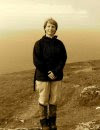
Oh, isn't nationalism such a big topic? It is a huge issue in all my classes, and it appears to be a highly conflicted one out there in the current messy world. Irish nationalism, and the question of Irishness, is, of course, a big deal because it was so uncool for awhile and now it is cool again. In my literature courses, one is looking at how the Anglo-Irish (people of English descent, generally middle to upper class, protestant) debate how Irish they are because they sure aren't English, but people whose ancestors are from Ireland (working to middle class, catholic) maintain they aren't really Irish. This debate about what makes a person Irish is fascinating. We are reading a number of novels from the the early 20th century where Anglo-Irish authors explore what makes them Irish. I highly recommend one by a person called Kate O'Brien called The Land of Spices which is about an English woman who grew up in Brussels, became a nun, and gets sent to Ireland to be the Mother Superior of a convent school in the 1920's. In this novel, you get the author setting up England vs. Ireland vs. Europe vs. Catholic Church vs. generalized patriarchy. And she does a really compelling job of it all too. And it's funny, in places. This nun is in her early 40's and has these emotional revelations about the place of emotion and control in her life. Maybe I really like the novel because I sort of identified with this character. Kendra, if you haven't already found Kate O'Brien, you might really like her stuff.
The Irish Lit Revival course is about Yeats, Lady Gregory, Synge, O'Casey et alia. My paper that I will present next week is about the evocation of Landscape in Yeats' poetry. I contrast his poetry (Ango-Irish, written in English trying to evoke a new Irishness) with the native Irish poetry of 13th century monks and 17th century poets who wrote in Irish. Poor Yeats was so alienated from the land this is clear in his poetic landscapes. For example, that (in)famous poem 'Innisfree' with the 9 bean rows, the bee-loud glade, and the evening full of linnets' wings: remember that one? Well, if you go back to it, you will see that it all happens in the future tense: in fact, it never happens. The only part of the poem in the present tense that is "real" is his standing on the grey pavement in London dreaming about this place in his 'deep heart's core'. This alienation or inability to connect with nature is clear in all of his stuff. His most real landscapes are the landscapes of the mind, such as in his poignant poem (made me cry the first time I read it) called 'The Desertion of the Circus Animals'. On the other hand, the guys writing in Irish had a very different relationship with nature: intimate and personal. The contrast of Yeats trying so hard to deal with nature and these guys just swimming in it give two equally Irish approaches to evoking landscape in art, and yet such divergent perspectives. The irony is that Yeats, in the literary revival, wanted to revive these very poets, this very sensibility, this 'Celtic Twilight'. He never learned Irish, and he could never really touch the land. Bless him, he's the poet laureat of Ireland. Priscilla, you would love these 13th century poems! Ann, you would recongize what these guys were talking about! I will see if I can get a copy of this text Early Celtic Nature Poetry to bring home to you.
Now the Irish Music class also wonders, "What is Irish about Irish music?" and the conclusion is a geographical definition. They all seem to agree that if it is something that happens through social relationships here on this island, then that qualifies it to be Irish. Thus, Scottish strathspeys played for awhile in Ireland are traditional Irish music. Polkas and mazurkas, same thing. I went to a concert earlier this week where Frankie Gavan, a very famous fiddler, played the 5th Brandenburg concerto in the form of a traditional Irish jig. It was amazing, humourous, and utter technical virtuosity. All the texts I read about 'traditional Irish music' all say the guitar is utterly useless in traditional Irish music. On the other hand, every traditional session I have been to here has had a guitar backing everybody up, not to mention the occaisional bazouki. I guess they are part of the evolution of the 'tradition' (like the mazurkas, strathspeys, and polkas) such that in about 50 years they will be added to the tradition. In my guitar class, the teacher's perspective is, if you have guitar, you can play anything and a soloist of any tradition will want you to back them. He seemed to regard the guitar as the ultimate traditional instrument cuz it can adapt to anything.
So, on one of the mountain walks I went on, up Mount Mangerton in Kerry, I asked one of the Irish guys (who was dating a Polish girl, which makes him a bit of an internationalist, don't you think?) what made him Irish. He said, "Well, I guess I come from a small enough country that we haven't really pissed off a lot of other countries, and we can hang onto a friendly reputation. Yeah, we're known for our friendliness."
Friday, September 28, 2007

Tuesday, September 25, 2007
The Landscape of Literature
Last Sunday I went with the local outdoor club, called the "Outdoor Pursuits Club", to visit the Burren in County Clare. The Burren is the desolate area on the west coast where a limestone escarpment meets the sea. We had to drive through a town called Ennis to get there, and I realized that a reel I was learning was called "the Siege of Ennis" and there we were driving through it, so I whistled that to myself for awhile. Then we had to drive through Lindisvoorna, and there was a sign that said "Lindisvoorna 15 km" and I remembered that I know a jig called "The Road to Lindisvoorna", so I whistled that one. Once we arrived at the Burren, I remembered that there is a very mournful song called "the West Coast of Clare" and, hey, that's where we were. So I sang that to myself as I walked around. That evening, on our way home from the day out, we stopped in a town called Doolin to have a pint, and there were two accordian players, a bodhran player, and a guitar player having a bit of a session. They played the Siege of Ennis and the Road to Lindisvoorna. It was wonderful to look around and be in the very places where these tunes came from. I am more and more convinced of the power of landscape in the evocation of art. I was so excited about this idea that I proposed it for my paper this morning in the Literary Revival class. The Professor (who I think is younger than me) raised his eyebrows, looked at me from the sides of his glasses, and said, "Okay: that's an interesting idea." I guess it was off the beaten literary track, and when I went to do the research, I found that it is not the lit folks writing much about this, it is cultural geographers and tourist industry people! So, I am very interested to put together a ten minute (ha ha) presentation on the idea for the lit class on Yeat's evocation of landscape in a romantic (re)construction of Irish landscape during the 19th and early 20th century Irish Literary Revival.
Anyway, the Burren is this limestone landscape that is sort of like the Slickrock area of Utah, only white, not red. This is where the cliffs of Moher are, which you must now pay to visit. However, just down the coast, in view of the Cliffs of Moher, it is free to climb down the cliffs and see the raging sea. It was a grey day with a stiff wind (they call it a "fresh breeze" here) and short periods of drenching horizontal rain blowing through (they call them "spotty showers"). We were rock climbing on the sea cliffs. The rock was sharp limestone cracks, and it was great good fun to climb. I got bored waiting in line for a belay, so I took some crash pads out to sort of boulder around. Some of the Gnarly Climber Dudes (Czech) joined me. One guy was very enthusiastic. He jammed his hands right into the cracks to motor right along. This was a mistake because the rock was pretty sharp, and instead of leaving a trail of chalk along the route, he left a trail of blood. When I pointed this out to him, as I was grossed out about having to follow what had become a rather slimey route, he looked at his abraded knuckles and seemed rather impressed with himself. He wandered off comtemplating, but not treating, the backs of his oozing hands.
A small group walked up further into the hills, and there were long stretches of dry-laid stone walls enclosing nothing. They were just walls stretching up the hillsides. These were left over from the 1840's during the famine time when the Whig government offered food for the poor, but they had to do work projects to earn the food since they did not want to seem to be handing out charity to starving people as that might encourage loafing or sloth or something sinful. It was stated in the government policy that the works could not have any practical purpose. If they did, then they would have had to pay wages for the work, and this was charity. No wait, it wasn't charity, but it couldn't be real work. It was a complicated and confusing time for everybody. Anyway, here were these walls, and it was clear that it took a lot of effort to make them. It was very sad to think about in the grey driving rain. The song called "the west coast of Clare" starts out: "Sorrow and Saddness/bitterness, grief/ memories I have of you/won't leave me in peace."
Anyway, the Burren is this limestone landscape that is sort of like the Slickrock area of Utah, only white, not red. This is where the cliffs of Moher are, which you must now pay to visit. However, just down the coast, in view of the Cliffs of Moher, it is free to climb down the cliffs and see the raging sea. It was a grey day with a stiff wind (they call it a "fresh breeze" here) and short periods of drenching horizontal rain blowing through (they call them "spotty showers"). We were rock climbing on the sea cliffs. The rock was sharp limestone cracks, and it was great good fun to climb. I got bored waiting in line for a belay, so I took some crash pads out to sort of boulder around. Some of the Gnarly Climber Dudes (Czech) joined me. One guy was very enthusiastic. He jammed his hands right into the cracks to motor right along. This was a mistake because the rock was pretty sharp, and instead of leaving a trail of chalk along the route, he left a trail of blood. When I pointed this out to him, as I was grossed out about having to follow what had become a rather slimey route, he looked at his abraded knuckles and seemed rather impressed with himself. He wandered off comtemplating, but not treating, the backs of his oozing hands.
A small group walked up further into the hills, and there were long stretches of dry-laid stone walls enclosing nothing. They were just walls stretching up the hillsides. These were left over from the 1840's during the famine time when the Whig government offered food for the poor, but they had to do work projects to earn the food since they did not want to seem to be handing out charity to starving people as that might encourage loafing or sloth or something sinful. It was stated in the government policy that the works could not have any practical purpose. If they did, then they would have had to pay wages for the work, and this was charity. No wait, it wasn't charity, but it couldn't be real work. It was a complicated and confusing time for everybody. Anyway, here were these walls, and it was clear that it took a lot of effort to make them. It was very sad to think about in the grey driving rain. The song called "the west coast of Clare" starts out: "Sorrow and Saddness/bitterness, grief/ memories I have of you/won't leave me in peace."
Friday, September 21, 2007
Being a "mature" student
At the University of Cincinnati, they would call a person like me a "non-traditional" student. Here the euphemism for person not between 18 and 22 is a "mature" student. "Mature" students are also quite rare here, or at least, there are more people like me at UC than there are at UL. There is a "mature" student group that I need to track down, but they do not seem to advertise themselves. The professors are not accustomed to having older students in class, and I have confused more than one instructor with questions that were not quite what they expected. Dad commented on my interaction with the history professor that I could argue my ideas by first acknowledging the professors idea and then extending it into my own idea, and that is a very good idea that I will try out on the history guy at the next tutorial. However, I have noticed that many people do not expect students to really have an idea so that they do not give the student enough time to formulate a full thought. This is another mental note to self: be sure to give students enough time to say something. It is hard to be on the spot and come up with a fully formed and coherent idea. Of course, a lot of students don't really have an idea to contribute, but for the ones who do, some time would be helpful.
The young man who teaches the Irish Language class is the youngest instructor, and he seems to deal best with non-traditional students as there are quite a number of them in his class. He in an inexperienced teacher, but he compensates by treating each person like a real human being with no professorial hubris. This respect is so important. Another mental note to self: no matter what, retain humility as a teacher! Some of these Senior Lecturers are so incredibly condescending that they just look right through a person. As a student, it can be pretty demoralizing. I hope I never did that: I know I will be extra careful from now on to never do that.
The guitar teacher is not like that at all. He is really a down to earth person, like the Irish language person. The music class is all 18-22, except for me, but he treats each student as an individual human being, even the jock who has no idea how to play the guitar. He is a real mensch. The teacher does play gigs, and I expect we'll hear about where he plays next week. It is a little hard for me to get to town gigs because the buses stop at 11:30, and most music doesn't get started until 9 or 10 at night. Most people take taxis home, but that is 10 Euro a pop, which is a little beyond my means. My task for Saturday is to scope the main traditional music venue, Dolan's Pub, and work out a safe way to run for the bus at 11:15 pm. I can hear my mother and husband shaking their fingers at me and saying, "Take the taxi, you jarhead!"
The young man who teaches the Irish Language class is the youngest instructor, and he seems to deal best with non-traditional students as there are quite a number of them in his class. He in an inexperienced teacher, but he compensates by treating each person like a real human being with no professorial hubris. This respect is so important. Another mental note to self: no matter what, retain humility as a teacher! Some of these Senior Lecturers are so incredibly condescending that they just look right through a person. As a student, it can be pretty demoralizing. I hope I never did that: I know I will be extra careful from now on to never do that.
The guitar teacher is not like that at all. He is really a down to earth person, like the Irish language person. The music class is all 18-22, except for me, but he treats each student as an individual human being, even the jock who has no idea how to play the guitar. He is a real mensch. The teacher does play gigs, and I expect we'll hear about where he plays next week. It is a little hard for me to get to town gigs because the buses stop at 11:30, and most music doesn't get started until 9 or 10 at night. Most people take taxis home, but that is 10 Euro a pop, which is a little beyond my means. My task for Saturday is to scope the main traditional music venue, Dolan's Pub, and work out a safe way to run for the bus at 11:15 pm. I can hear my mother and husband shaking their fingers at me and saying, "Take the taxi, you jarhead!"
Thursday, September 20, 2007
Mad Dog Baroque
I just went to hear Piers Adams play a bunch of baroque recorder sonatas with the Irish Chamber Orchestra. I sat waayyy back in the nosebleed seats which were 1/3 of the regular price, and it turns out that the sound at the back of the hall was fantastic. If you have not heard of this guy, he is, if you can believe it, the Bad Boy of baroque recorder. His promotional materials shows him in dark hyper-hip sunglasses holding a trio of recorders on the shoulder of his open fronted black silk shirt. The baroque is now officially Hot.
The costume of the Irish Chamber Orchestra for the gentlemen is the frock coat. They really looked quite good! The women wore the usual black dresses, but one second violinist was wearing a sparkly hip black chemise top that looked like she might go clubbing after the concert. Mr. Adams was also a frock coated dude, but it was a Bad Boy frock coat. No, really. He came out on stage to play the first four sonatas on a treble recorder wearing a black velvet frock coat with leather pockets, collar and cuffs. The leather had brass rivets in it. He was wearing a white collarless silk shirt with a purple sash tied low slung across his hips. And he was wearing leather pants. He jumped and grooved while he played, and he played those recorders like the hounds of hell were after him. I swear, if you have not heard this guy play, find his Vivaldi CD: it is jaw dropping virtuosity. And, with the costume and the incredible skill, he was also a funny show-guy. He introduced the descant recorder as "the angry stick feared by parents the world over." He also commented, "Some people say Vivaldi wrote 400 sonatas, but they maintain it was really just the same sonata 400 times. That's not really fair. I have selected four that I hope will show you that there were at least four different ones."
The other two concerts I have attended so far have been Irish rock bands a la U2. I went with the anthropological intention of finding out what Young People These Days are really crazy about, and these two bands had tremendous hype and anticipation. One was called the Blizzards which played to a sold out crowed of skimpily dressed students, and the other was a more soulful and yet just as loud band called Director. They were carding people at the door, but they did not ask me for ID. Jeez: I wonder why? ;-) I guess wrinkles are good for something as I did not have any ID on me. They also frisked everyone for knives. Good think I left my knife at home with my ID! I cannot comment on the music of these two bands as they appeared to contain the same four chords with the same backbeat, but presented in slightly different orders. None of the guitar players had any real technique to speak of, and it seemed like it was really just about the beat. However, the dancing of the crowd seemed to limit itself to hopping up and down with one hand in the air. Nevertheless, the student paper reported both concerts to be wild successes highly praised by all. I thought the most interesting praise was from a young man quoted in the paper in reference to the lead singer of The Blizzards, "If there were a reason to turn gay, it would be for him."
The costume of the Irish Chamber Orchestra for the gentlemen is the frock coat. They really looked quite good! The women wore the usual black dresses, but one second violinist was wearing a sparkly hip black chemise top that looked like she might go clubbing after the concert. Mr. Adams was also a frock coated dude, but it was a Bad Boy frock coat. No, really. He came out on stage to play the first four sonatas on a treble recorder wearing a black velvet frock coat with leather pockets, collar and cuffs. The leather had brass rivets in it. He was wearing a white collarless silk shirt with a purple sash tied low slung across his hips. And he was wearing leather pants. He jumped and grooved while he played, and he played those recorders like the hounds of hell were after him. I swear, if you have not heard this guy play, find his Vivaldi CD: it is jaw dropping virtuosity. And, with the costume and the incredible skill, he was also a funny show-guy. He introduced the descant recorder as "the angry stick feared by parents the world over." He also commented, "Some people say Vivaldi wrote 400 sonatas, but they maintain it was really just the same sonata 400 times. That's not really fair. I have selected four that I hope will show you that there were at least four different ones."
The other two concerts I have attended so far have been Irish rock bands a la U2. I went with the anthropological intention of finding out what Young People These Days are really crazy about, and these two bands had tremendous hype and anticipation. One was called the Blizzards which played to a sold out crowed of skimpily dressed students, and the other was a more soulful and yet just as loud band called Director. They were carding people at the door, but they did not ask me for ID. Jeez: I wonder why? ;-) I guess wrinkles are good for something as I did not have any ID on me. They also frisked everyone for knives. Good think I left my knife at home with my ID! I cannot comment on the music of these two bands as they appeared to contain the same four chords with the same backbeat, but presented in slightly different orders. None of the guitar players had any real technique to speak of, and it seemed like it was really just about the beat. However, the dancing of the crowd seemed to limit itself to hopping up and down with one hand in the air. Nevertheless, the student paper reported both concerts to be wild successes highly praised by all. I thought the most interesting praise was from a young man quoted in the paper in reference to the lead singer of The Blizzards, "If there were a reason to turn gay, it would be for him."
Tuesday, September 18, 2007
Learning in the Oral Tradition
Because I am taking courses in both traditional Irish studies and regular courses, there is an interesting approach to the nature of learning. In the History course and the Literature course, the two courses in the European literary tradition, there are set texts, one goes to a lecture and listens, one goes to the tutorial and learns how to repeat back the party line that the course is teaching. At least the History lecturer frames the repetition as critical thinking, but I know it is really a game of Guess the Agenda. I know this by trial and error (my error, of course). We were talking about the concept of republic as espoused by Wolfe Tone in Ireland in the 1790's. Now, of course, the Party Line is that Wolfe Tone conceived of the republic as a goverment of the people (i.e. no monarch) in the French sense which meant parliamentary reform for Ireland. He was also in favor of Catholic emancipation. These are the Right Answers. Well, when the lecturer got to me, I had been reading about the import/export taxes and the fact that the Anglo-Irish protestants were pissed off about parliament because it was cutting into profits, and the Catholics were all about emancipation so as to have better political participation in the free market. Thus, I said there was an economic factor to Wolfe Tone's republic that was not necessarily outlined by the French idea because of this emancipation thing that would bring more people into participation in the market. The lecturer hemmed and hawed, and eventually indicated (but not in a nasty way, just in a clear way) that he did not believe that economics were an essential part of Wolfe Tone's concept of the republic for Ireland. I was annoyed, and after class, I found a reference for exactly what I said. Nevertheless, I did learn what the tutorial was for, and I will see if I play Guess the Agena better next time.
Now the folklore course, the Irish music course, and the Irish language course are firmly based in the oral tradition. There are no texts. Of course there is a bibliography of suggested readings, but the tutorials are all about Being Present. In the Folklore tutorial, we did a choral reading of a famous poem composed to keen the death of a beloved husband. We chorused the lines of the poem back to the lecturer as she said them, and the rhythm of the poem leapt out because the class was speaking. Not only that, but there were no printed words to distract so the emphasis on the spoken language was heightened. I so come from the literary tradition, that I went and found the text in the library after, but the power of the spoken poem was so much stronger than the text.
In the music class, our tutorials are expressly on doing music. I am taking a guitar tutorial. There are four other young boyz in the class and the Tutor, who I will now refer to as Eoin (/owen/). The boyz include one blues guy, one rather accomplished and tense folk player, one hard core rocker, and one clueless jock whose presence in the class is oddly fascinating due to its apparent utter randomness. Blues, Folk, and Rocker are all very interested in making sure everybody else knows They Can Play, and they make a point of doing little licks at random points such that their skill may be subtly demonstrated to each other. Eoin finally said, 'Okay, enough fancy stuff lads. Time to focus.' Eoin is the one who is truly skilled, as he should be, and I must say, he did indulge his demo licks also, but because he was alpha, I suppose it was required to get The Lads in line. As an old lady (among the 18 year olds I am a quasi Crone (in the best sense of the term, of course), I am exempt from all of these displays and can just be a highly entertained audience. Anyway, because this is a traditional music course, it is all by ear. There are no books, nothing printed. We learn the tunes by watching and hearing Eoin play them. Again, the non-text learning is so immediate and so intense. As a literary based person, it is tiring because the focus on the moment must be so complete.
The Irish language class also has no text. It is all about listening to the lecturer and repeating. There is no text because we are studying the standard European curriculum for Irish, and evidently they are still creating the written texts. I experience the same competence/performance disjunct here, as in all languages, where I am fluent inside my head but there is a static inducer somewhere between brain and mouth such that the sounds that come out of my mouth are only slightly representative of what goes on in my brain. I found the Irish language TV station and listen to the Gaeilge news in the evening. It is a strange language and with this style of learning, hard for me to get a grip on. I find that I wish there were a bit more explicit grammar. But the poor lecturer is still sorting out how to do a communicative curriculum. To his credit, he has catered to my grammar questions when I pose questions, but I can see he is a little flummoxed by how to present them. He said, "The grammar is hard." and I replied, "But all grammar is hard, but it can be fun!" Clearly he thought I was "away with the fairies" as they say.
After all this academic silliness, I went to the climbing wall and fell off the wall for 45 minutes as a break from studying and practicing guitar. The indoor climbing wall in the gym is about the size of a large living room, has two top ropes and two bouldering sections. There were a number of Europeans there looking smokey, silent, and suave as they wafted up and down the boulder routes. There was an insecure American girl talking too loudly, and two Irish lads earnestly dissecting a route. I messed around in-between the smokey guys traverses until my forearms couldn't take it, and I went home for some Toast and Tea.
Now the folklore course, the Irish music course, and the Irish language course are firmly based in the oral tradition. There are no texts. Of course there is a bibliography of suggested readings, but the tutorials are all about Being Present. In the Folklore tutorial, we did a choral reading of a famous poem composed to keen the death of a beloved husband. We chorused the lines of the poem back to the lecturer as she said them, and the rhythm of the poem leapt out because the class was speaking. Not only that, but there were no printed words to distract so the emphasis on the spoken language was heightened. I so come from the literary tradition, that I went and found the text in the library after, but the power of the spoken poem was so much stronger than the text.
In the music class, our tutorials are expressly on doing music. I am taking a guitar tutorial. There are four other young boyz in the class and the Tutor, who I will now refer to as Eoin (/owen/). The boyz include one blues guy, one rather accomplished and tense folk player, one hard core rocker, and one clueless jock whose presence in the class is oddly fascinating due to its apparent utter randomness. Blues, Folk, and Rocker are all very interested in making sure everybody else knows They Can Play, and they make a point of doing little licks at random points such that their skill may be subtly demonstrated to each other. Eoin finally said, 'Okay, enough fancy stuff lads. Time to focus.' Eoin is the one who is truly skilled, as he should be, and I must say, he did indulge his demo licks also, but because he was alpha, I suppose it was required to get The Lads in line. As an old lady (among the 18 year olds I am a quasi Crone (in the best sense of the term, of course), I am exempt from all of these displays and can just be a highly entertained audience. Anyway, because this is a traditional music course, it is all by ear. There are no books, nothing printed. We learn the tunes by watching and hearing Eoin play them. Again, the non-text learning is so immediate and so intense. As a literary based person, it is tiring because the focus on the moment must be so complete.
The Irish language class also has no text. It is all about listening to the lecturer and repeating. There is no text because we are studying the standard European curriculum for Irish, and evidently they are still creating the written texts. I experience the same competence/performance disjunct here, as in all languages, where I am fluent inside my head but there is a static inducer somewhere between brain and mouth such that the sounds that come out of my mouth are only slightly representative of what goes on in my brain. I found the Irish language TV station and listen to the Gaeilge news in the evening. It is a strange language and with this style of learning, hard for me to get a grip on. I find that I wish there were a bit more explicit grammar. But the poor lecturer is still sorting out how to do a communicative curriculum. To his credit, he has catered to my grammar questions when I pose questions, but I can see he is a little flummoxed by how to present them. He said, "The grammar is hard." and I replied, "But all grammar is hard, but it can be fun!" Clearly he thought I was "away with the fairies" as they say.
After all this academic silliness, I went to the climbing wall and fell off the wall for 45 minutes as a break from studying and practicing guitar. The indoor climbing wall in the gym is about the size of a large living room, has two top ropes and two bouldering sections. There were a number of Europeans there looking smokey, silent, and suave as they wafted up and down the boulder routes. There was an insecure American girl talking too loudly, and two Irish lads earnestly dissecting a route. I messed around in-between the smokey guys traverses until my forearms couldn't take it, and I went home for some Toast and Tea.
Friday, September 14, 2007
Time disjunct: end of week 1
My schedule is now set, which is a relief. Change and flux are always energy consuming and tiring. I caught a cold earlier in the week, and it is just now settling out. Despite my anxious desire to Go Do Something, I have been sitting still and reading, and there is a lot of reading to do! I am taking five courses and auditing one. I would do more if I could! I feel like I want to squeeze every moment of learning out of the short time I am here. I am so focused on Learning Everything that time feels out of joint. It is like I have stepped out of the normal time I inhabit into this parallel universe where Ohio and Massachusetts do not exist as real places. Being by myself contributes to the utter focus on study. At home I hang out, play with the dogs, lie on the couch and enjoy a cat or two, go out to dinner with my honey and talk about Stuff, but here it is all about going to class, preparing for class, or doing an activity. Contributing to this constant prompt to action is the fact that this campus does not cater to sitting outside. There are few benches in the common areas, and there are few places to sit in the wide windowed hallways of the buildings. Each building has some kind of cafe, and there are lots of places to sit there, but outside of an eating place, there are few places to just sit. It would seem that the only reason a person would sit (outside of the library) would be to consume something. This arrangement does not promote much outdoor gathering, which would make sense in a rainy, cold place. They say there were 69 straight days of rain this summer. It has not rained once since I have arrived.
Photos of the dorm and campus are up on snapfish:
http://snapfish.com
login as me: ruth.benander@gmail.com
password: Aiz600
Today I had Literary Revival and Irsh Language. In the Revival course, Dr. Aidan talked about how Irish nationalism was most important to the British people who had moved to Ireland earlier in the colonial period, had a few generations under their familial belts, and now sort of identified with the Irish. The people who were reviving the Irish language were monolingual English speakers looking for some kind of romantic, spiritual identity by construction some kind of cultural nationalism for themselves. The "peasants" were seen as some kind of authentic Irish who needed to be told that they were the "real Irish". It seems that there was some kind of feeling of the "noble savage" going on. In the 20th century lit class, we are reading a novel about these people in 1920 which asserts that these "Anglo Irish" or "The Protestant Ascendancy" thought they were Irish, or rather knew they weren't as British as the people from England were, but still had no idea what it was to be Irish from the point of view of the people who had always lived in Ireland. So it seems that early 20th century Irish national identity was created by out-of-touch upper-class romantics, but further honed, later on, by people who belonged to other classes, religions, and cultural backgrounds. Rather messy, which makes it all the more interesting.
The Irish language class remains a hoot. The teacher, Padraigh, has a masters in Irish but not in pedagogy. He's a nice guy, but I think he is not very organized in a communicative classroom although he does make an effort to run a communicative classroom. It's just that he has a hard time organizing the students to faciliate beginner speaking. We did a basic dialog of "hi how are you, fine thanks, what's your name, where are you from, what is your phone number, I have to go now, bye." I thought of the basic ALM dialogs like "ou est Anne, a la piscine, avec qui, avec Claude" or the beginning Latin "Puer in via laborat" stories. It would be really funny to create screen plays or short stories based on these surreal basic language encounters. Like the basic Irish dialog where you meet someone, ask their name, country of origin, and then go striaght to asking for a phone number: it sounds like a sleazy bar encounter. Or the French dialog could be a soap opera encounter where Claude and Anne are having an illicit affair. Thomas and Granny! Get a video camera: we'll start shooting next spring.
Padraigh said he was optimistic that by 2010, Irish would be firmly re-rooted in ireland. Then he told an anecdote about how he was on the bus, and all the people around him were on their cell phone talking in Polish and Czech and English. His phone rang, and he started talking in Irish to one of his colleagues, and he says people on the bus stopped and stared at someone speaking Irish. I am highly entertained by these lectureres who make an assertion and then immediately tell an anecdote that contradicts the assertion. The folklore lecturer did that too. At the end of Irish class, he said, "Go home and practice." "How?" we asked. "You know," he said, apparently puzzled by our question, "Make little cards. Learn the phrases." I had to laugh (in my mind). No text, no exercises: go home and memorize the words I said to you today. Very interesting.
Photos of the dorm and campus are up on snapfish:
http://snapfish.com
login as me: ruth.benander@gmail.com
password: Aiz600
Today I had Literary Revival and Irsh Language. In the Revival course, Dr. Aidan talked about how Irish nationalism was most important to the British people who had moved to Ireland earlier in the colonial period, had a few generations under their familial belts, and now sort of identified with the Irish. The people who were reviving the Irish language were monolingual English speakers looking for some kind of romantic, spiritual identity by construction some kind of cultural nationalism for themselves. The "peasants" were seen as some kind of authentic Irish who needed to be told that they were the "real Irish". It seems that there was some kind of feeling of the "noble savage" going on. In the 20th century lit class, we are reading a novel about these people in 1920 which asserts that these "Anglo Irish" or "The Protestant Ascendancy" thought they were Irish, or rather knew they weren't as British as the people from England were, but still had no idea what it was to be Irish from the point of view of the people who had always lived in Ireland. So it seems that early 20th century Irish national identity was created by out-of-touch upper-class romantics, but further honed, later on, by people who belonged to other classes, religions, and cultural backgrounds. Rather messy, which makes it all the more interesting.
The Irish language class remains a hoot. The teacher, Padraigh, has a masters in Irish but not in pedagogy. He's a nice guy, but I think he is not very organized in a communicative classroom although he does make an effort to run a communicative classroom. It's just that he has a hard time organizing the students to faciliate beginner speaking. We did a basic dialog of "hi how are you, fine thanks, what's your name, where are you from, what is your phone number, I have to go now, bye." I thought of the basic ALM dialogs like "ou est Anne, a la piscine, avec qui, avec Claude" or the beginning Latin "Puer in via laborat" stories. It would be really funny to create screen plays or short stories based on these surreal basic language encounters. Like the basic Irish dialog where you meet someone, ask their name, country of origin, and then go striaght to asking for a phone number: it sounds like a sleazy bar encounter. Or the French dialog could be a soap opera encounter where Claude and Anne are having an illicit affair. Thomas and Granny! Get a video camera: we'll start shooting next spring.
Padraigh said he was optimistic that by 2010, Irish would be firmly re-rooted in ireland. Then he told an anecdote about how he was on the bus, and all the people around him were on their cell phone talking in Polish and Czech and English. His phone rang, and he started talking in Irish to one of his colleagues, and he says people on the bus stopped and stared at someone speaking Irish. I am highly entertained by these lectureres who make an assertion and then immediately tell an anecdote that contradicts the assertion. The folklore lecturer did that too. At the end of Irish class, he said, "Go home and practice." "How?" we asked. "You know," he said, apparently puzzled by our question, "Make little cards. Learn the phrases." I had to laugh (in my mind). No text, no exercises: go home and memorize the words I said to you today. Very interesting.
Thursday, September 13, 2007
Not In the System
As a "Study Abroad" or "International Student," I am not "in the system." This means many things. First it means that I do not receive the adminstrative emails that help students know that there are Things that Must Be Done. Also, I won't show up on the professors' class lists for a few weeks. This also means that I don't quite know what is expected at any given time, and, because of my accent, I am exempted from a lot of expectations after the double take accompanies acknowledgement of "oh, now I am talking with a foreigner."
Three of the professors am taking courses with are very traditional. Not very approachable and very serious about their work. The History professor, Dr. John Logan, was insistent that I bring a stamped document that indicated that I was enrolled in his course. This confused the International Education Office, but I convinced them this piece of paper would make Dr. Logan very happy. I made sure two people in the office signed it with their phone numbers. When I handed Dr. Logan this piece of paper, he peered at it both through his glasses and over his classes while he bent forward for this inspection of my stamped piece of paper. I am sure it did not make sense as I am equally sure he had never seen this form before, but it DID have the stamp on it, so he allowed me to sign up for a tutorial.
His colleague in the English Department is as serious and imperious. She teaches the literature course that had the "foreigners not welcome" sign on the syllabus. She began the class by informing the students there were too many people in the room, and she hoped half of them would leave because they were probably not prepared for the material. After having said this, she then said this course used to be called "Joyce to Derrida" (read obscure and hard to understand to obscurer and harder to understand) and it would only get about seven people to attend (duh). So her department made her change the course to be a survey of 20th century Anglo Irish literature so it would be able to compete with the science fiction course which was always packed. Well, clearly, from the packed room, the change was quite successful. However, I could not get over the cognitive dissonance of her complaining that there were too many people. Of course, then she began to survey the class about who had read any Joyce before, or who recognized the other authors she was mentioning. More than half of the Irish students had no idea what she was talking about, and the one person who had read several of the authors she was mentioning was an American girl in the back of the room. I was laughing (in my mind). There she was, up on her high horse, all alone except for this really embarassing Yank who read stuff her precious little majors had no clue about. She did seem a bit disoriented by this state of affairs, to her credit, but then overcame her own cognitive dissonance and soldiered on. She had unorganized handouts for only about half the class, couldn't work the computer very well, but did make very interesting points about the general themes that would be covered in the class. I later went to her office hours to ask if I might just sit in on the lectures, and she very nicely said I could. This seems like a good arrangement to me as I would rather just enjoy the lectures and the texts and not worry about working through her expectations of student writing which seem like they would be stressful and hard to guess.
The Irish Language class is the livliest I have been to yet because it is full of people from the Irish Music and Dance program, and these are women my age. Well, you can't get more fun than that! They talk and laugh and participate like nobody's business. The poor adjunct who was running the class didn't know what times the tutorials met or anything. He read the syllabus and left it at that. He couldn't answer any questions, had no phone, and no email. He was wearing a blue faded t-shirt and brown wide-wale courdoroy pants whose cuffs were frayed at the heel. The accordian player behind me thought he was hot stuff and loudly warned all the young ladies across the room to keep their eyes on their note books and not be distracted by the hottie teacher. He turned bright red. It went well with the blue shirt and brown pants. This woman will prove to be a total hoot, I'm sure. The teacher seems inexperienced enough to be very traditional or totally unorthodox. This is supposed to be a conversation class, so it will be interesting to see where he will fall on the teaching spectrum.
Wednesday night I signed up for two student clubs: aikido and Outdoor Pursuits. The student club life here is very active and all the student clubs had turned out, in appropriate costumes, to recruit members on the basket ball courts of the university sports arena. Judo guys and Shotokan karate guys were out on some wrestling mats taking on all comers in little matches. Each club had a little booth and little registration cards. If they were really into it, they had props like boats or tents or these little wrestling matches. The skydiving club had hung a parachute over their booth, and some club had a guy dressed up like a devil (pitchfork, horns, cape, fangs) walking around putting red pieces of paper in people's hands. I don't know what he was promoting, but he really had the looming over victims act down well. The saddest booth was the chess club. It was just a booth with a chess set and a silent, motionless person sitting behind it. No decorations, nothing: just a hand-lettered sign that said "Chess Club". I did not see any one sign up for chess, probably because the pen sitting beside their sign up book had no ink cartridge in it: it was only a plastic pen shell. It was so poignant.
Three of the professors am taking courses with are very traditional. Not very approachable and very serious about their work. The History professor, Dr. John Logan, was insistent that I bring a stamped document that indicated that I was enrolled in his course. This confused the International Education Office, but I convinced them this piece of paper would make Dr. Logan very happy. I made sure two people in the office signed it with their phone numbers. When I handed Dr. Logan this piece of paper, he peered at it both through his glasses and over his classes while he bent forward for this inspection of my stamped piece of paper. I am sure it did not make sense as I am equally sure he had never seen this form before, but it DID have the stamp on it, so he allowed me to sign up for a tutorial.
His colleague in the English Department is as serious and imperious. She teaches the literature course that had the "foreigners not welcome" sign on the syllabus. She began the class by informing the students there were too many people in the room, and she hoped half of them would leave because they were probably not prepared for the material. After having said this, she then said this course used to be called "Joyce to Derrida" (read obscure and hard to understand to obscurer and harder to understand) and it would only get about seven people to attend (duh). So her department made her change the course to be a survey of 20th century Anglo Irish literature so it would be able to compete with the science fiction course which was always packed. Well, clearly, from the packed room, the change was quite successful. However, I could not get over the cognitive dissonance of her complaining that there were too many people. Of course, then she began to survey the class about who had read any Joyce before, or who recognized the other authors she was mentioning. More than half of the Irish students had no idea what she was talking about, and the one person who had read several of the authors she was mentioning was an American girl in the back of the room. I was laughing (in my mind). There she was, up on her high horse, all alone except for this really embarassing Yank who read stuff her precious little majors had no clue about. She did seem a bit disoriented by this state of affairs, to her credit, but then overcame her own cognitive dissonance and soldiered on. She had unorganized handouts for only about half the class, couldn't work the computer very well, but did make very interesting points about the general themes that would be covered in the class. I later went to her office hours to ask if I might just sit in on the lectures, and she very nicely said I could. This seems like a good arrangement to me as I would rather just enjoy the lectures and the texts and not worry about working through her expectations of student writing which seem like they would be stressful and hard to guess.
The Irish Language class is the livliest I have been to yet because it is full of people from the Irish Music and Dance program, and these are women my age. Well, you can't get more fun than that! They talk and laugh and participate like nobody's business. The poor adjunct who was running the class didn't know what times the tutorials met or anything. He read the syllabus and left it at that. He couldn't answer any questions, had no phone, and no email. He was wearing a blue faded t-shirt and brown wide-wale courdoroy pants whose cuffs were frayed at the heel. The accordian player behind me thought he was hot stuff and loudly warned all the young ladies across the room to keep their eyes on their note books and not be distracted by the hottie teacher. He turned bright red. It went well with the blue shirt and brown pants. This woman will prove to be a total hoot, I'm sure. The teacher seems inexperienced enough to be very traditional or totally unorthodox. This is supposed to be a conversation class, so it will be interesting to see where he will fall on the teaching spectrum.
Wednesday night I signed up for two student clubs: aikido and Outdoor Pursuits. The student club life here is very active and all the student clubs had turned out, in appropriate costumes, to recruit members on the basket ball courts of the university sports arena. Judo guys and Shotokan karate guys were out on some wrestling mats taking on all comers in little matches. Each club had a little booth and little registration cards. If they were really into it, they had props like boats or tents or these little wrestling matches. The skydiving club had hung a parachute over their booth, and some club had a guy dressed up like a devil (pitchfork, horns, cape, fangs) walking around putting red pieces of paper in people's hands. I don't know what he was promoting, but he really had the looming over victims act down well. The saddest booth was the chess club. It was just a booth with a chess set and a silent, motionless person sitting behind it. No decorations, nothing: just a hand-lettered sign that said "Chess Club". I did not see any one sign up for chess, probably because the pen sitting beside their sign up book had no ink cartridge in it: it was only a plastic pen shell. It was so poignant.
Subscribe to:
Posts (Atom)