Monday, October 15, 2007

Dingle Vikings


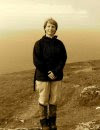
I loved typing that title. What a funny combination of words, but really, today I am talking about Vikings in Dingle. This picture (above) is me interacting with the Ogham Stone on top of Slea Head. I went to the Dingle peninsula with my Gaeilge class. The Irish language department paid for our bus fare and our conference fee. We just had to pay for accommodation! What a great way to support students, huh? I was glad to benefit from their generosity, and the trip was great. However, I had learned my lesson last weekend, and I booked a B&B at a farmhouse two miles from the student hostel. That turned out to be a good move because when I checked in with one of the young people who stayed in the hostel, they were, indeed, drinking heavily, screaming, and running around until 5:00 am. My young informant told me that she was so tired that she went to bed early while they were still screaming. She went to bed at 4:00. Personally, I got home at the elderly person's early hour of 1:00 am and slept to the sound of the atlantic ocean caressing the cliffs just below the farmhouse.

The conference was great. There were about 150 people there, the majority of whom were native speakers of Irish. I got to practice all my little social formulas like "please", "thank you", and "pleased to meet you." I also got to practice my literacy with "chugat" and "uiatch" (push and pull on the doors). Nothing like experiential learning, I tell you. The lectures were mostly in Irish with simultaneous translation in English on headphones. It was a little disorienting to hear a woman's voice speaking in my ears while a man stood lecturing at the podium, but after a minute of disorientation, it was sort of cool to utterly adjust ones gender norms.

The lectures dealt with the influence of Scandinavian culture in the western isles of Ireland. Many place names and words for money and fishing are of Scandinavian origin in Gaeilge. There was much discussion of the "plundering" that the norse did in reference to the monasteries, and there was much mention of the battle of Contarf where Brian Boru sent the Viking's packing for about 15 years, but really the focus was more linguistic than anything else. One 89 year old gentleman, who did not speak Gaeilge, asked for the microphone for three minutes, and in four minutes he gave a little polemic about how silly it was to speak of "plundering" as if that was all the scandinavians did. He mentioned the economic centers of Dublin, Waterford, Limerick, and Cork (which remain the economic powerhouses of Ireland today), and he mentioned that the stereotype of a man with horns on his head burning everything in sight was a terrible stereotype and a minority of the good people who came to stay and assimilated into Irish culture. He was really quite het up. He was very politely received by the Norwegian, Danish, and Finnish members of the audience. Then the next lecturer got up after that and gave a lecture about about the "plundering vikings."

The social aspects of this conference were quite different from the other academic conferences I have been to. First it was very small, so everybody sort of knew everybody else. Also, Dun Chaoin, the town, is very very small. The center of town is Kruger's Pub, where everybody went to after the conference ended, where they all proceeded to drink heavily. I learned a lot by sitting next to these slowly inebriating scholars and listening to them expound in the corner of the pub. There was lots of music too. There were two uillean pipers, one guitar, two fiddles, one accordian player, and one concertina player. There was also a man who did sean nos dance to a few tunes, and another young man who sang an aire. In general, they played and all the patrons continued their conversation. The noise level was astounding as people spoke over the music. However, when there was a solo, like the sean nos dance, a fiddle solo, or the singing of the aire, then whole pub went silent and listened. The level of communitas among all these people was very high.

After listening to all this talk of the Blasket islands, I wanted to get out and contemplate the landscape of the lectures, so Sunday morning I walked out on the Slea Head. Those pictures are posted on my snapfish site. I have posted how to get to my snapfish page in the post just before this, if you want to see pictures of Slea Head and Dingle. It was raining a little, and the wind was up. It was great to be out in the grey day admiring the moss, listening to the sea, and thinking about viking longships coming up the bay. Here is a sign that gives you all the options you have at Slea Head: parking for plundering vikings, and a picnic with a view. You don't get that combination of choices just everywhere...

Thursday, October 11, 2007

Photos of Connemara and Kylemor


If you want to see some photos from the Connemara trip which inspired the one act play "Dead Right in Letterfrack" (see an earlier post), you can log onto Snapfish. Go to http://snapfish.com and login as me: ruth.benander@gmail.com, Aiz600. I have also posted pictures from our visit to Kylemor Abbey, a Benedictine convent.

Mongolian Singers

So I went to see a concert of Mongolian traditional singers. The type of singing they do has been designated a national treasure by UNESCO, so it was kind of a big deal. They were a very interesting expression of what "tradition" means in a global culture. They wore shockingly brightly colored silk robes. The men wore bright yellow and orange silk tunics that fell to their ankles. The tunics had the high collars and the cavalary style closure on the sides. The tunics were also heavily embroidered with swirls and had dark contrasting piping all round the garment. Around the tunics they wore huge six inch wide belts. One guy had turqoise studs all over his belt. Their boots were also heavily embroidered with swirls and were turned up at the toe like elf boots. When the men walked, one could see the blue jeans peeking out from the tops of the boots. The youngest of the musicians had black hair with yellow highlights and enough mousse to puff his hair out like a rock star. When he played the horse head fiddle he totally rocked out like he was on MTV, not a traditional music stage. He was the embodiment of cultural synchretism: a young man who clearly loved Hendrix (he clearly copied Hendrix guitar moves on the horse head fiddle) but who was a virtuoso at an ancient tradition of singing and fiddle playing. The one woman who was part of the group was a little person, which probably accounted for the knee high four inch heeled black boots she was wearing. Her silk dress came to just above her knees, and it was much more Chinese looking than the wild tunics the men wore. She wore heavy western makup that made her face very shiny in the stage lights. But when she sang, this little person put out a huge sound. She sang the Mongolian Long Song style which has a lot of ornamentation and tremendous dynamics going from a room filling opera sound to a soft sweet whisper in the same phrase. It was beautiful, but I was on the edge of my seat because I was afraid she would fall off her boots while she was singing, and it would have been a long fall!

The group of four singers had two instruments: a two stringed fiddle with an ornate horse head carved on the finial, and goose headed mandolin type two stringed instrument. the goose head had a bright red beak! It was sharp such that if the player really rocked out, he could put out an eye. Two of the men sang the two tone throat singing where the the singer sings two notes at the same time, an octave apart. That was another big sound, and it sounded almost super human. One of the singers seemed to be the throad singing specialist, and when he stood to sing, he was so relaxed. He hooked his thumbs into his wide leather belt and looked like he was just standing in line for a bank teller machine or something, but he was making this huge sound that resonated like a bagpipe!

They sang love songs, songs about missing one's home town, and songs about their national hero. All the same content as Irish traditional songs, really. When they played and sang they did not tap their feet, but in the Irish tradition, the musician always taps one foot to the beat, sometimes very loudly such that it is part of the tune. So there were these Mongolian people singing with motionless feet, and there was the Irish audience, tapping away with their feet.

Monday, October 8, 2007

Dead Right in Letterfrack: a one act play


Dead Right in Letterfrack
A One Act Play

Connor, 21 years old, Irish
Fergus, 21 years old, Irish
Ruth, 44 years old, American
Julia, 33 years old, Danish
Bus Driver, 50 years old, Irish
Girls, between 19 and 22 years old, German/French/Spanish/Irish
Boys, between 19 and 22 years old, German/French/Spanish/Irish

Letterfrack is a town in Connemara.

Scene i
[An empty bus sits at the stop. A group of students stand around with backpacks, waiting]
Connor [runs up carrying three backpacks, out of breath, throws pack to the ground, begins shouting]: Nobody get on the bus! Don’t let anyone get on the bus!
Fergus [leaning against a wall, tweed cap askew]: It’s not our bus, Connor.
Connor: Oh. [pause] So I’ve got the list anyway. [He bustles around ticking people off the list who are present].
[the empty bus pulls out and another bus pulls in.]
Connor [stuffs list into one of his packs]: Everybody get on the bus! Put your things in the boot! Get on the bus! This is our bus!
Girl: Fergus has fuckin’ stupid hair!
[general laughter]
Fergus: Hey! Where have your hands been!
Girl: In your fuckin’ hair! [Shrieks with laughter]
[the group slowly boards the bus]
[On the bus.]
Connor [striding up and down the aisle of the bus]: Okay! Everybody sit down! Hey! Sit down! Listen up, lads: I have to count ye so sit down!
Fergus [to the bus driver]: This’ll be a pisser.
[A girl comes running towards the bus, her back pack bouncing as she runs full tilt for the bus. ]
Fergus [shouting out the door of the bus]: Hurry up! We’re leavin’ now!
Connor: Stow your pack in the back, in the boot! Fergus, put her pack in the boot!
[the girl tries to get on the bus, but the driver inches the bus forward each time she tries to get on. ]
Fergus: Ya fuckin’ crazy bastard! [laughing. Pushes girl into the bus and jumps in behind her.]
Bus Driver: I’ll hafta see yer ID before you can get on the bus.
Girl [confused]: Okay [starts to open her day pack]
Ruth: No, no. It’s okay. He’s just playing. You don’t have to show any ID. [Pulls girl past bus driver]
Fergus and Bus Driver laugh.


Scene ii
[Two hours later. The bus pulls into a shopping center.]
Connor: Okay! Listen up lads! We’re stopping at this Tesco for fifteen minutes! Got that? Fifteen minutes! [He gets off the bus first and as each person gets off the bus he says]: Fifteen minutes!
[Forty minutes later. The students return to the bus, most bringing cases of Molson Gold. Connor and Fergus carry two cases each.]
Bus Driver: No drink on the bus. Put it all in the boot.
[The bus fills. As it pulls out of the parking lot, there is the sound of bottles opening in the back of the bus. Soon after, the back of the bus is howling 1980’s broadway show tunes, singing one word of the lyrics in three.

Scene iii
[The bus arrives in Letterfrack and comes to a halt in the center of the village. There is a pub to the right, and a pub to the left. It is full dark.]
Connor: Get off the bus! Everybody get off the bus! We’re here!
[People disembark. Connor and Fergus hurl all the packs in the back of the bus into the road behind the bus. Ruth and Julia retrieve their packs and walk into the darkness following a sign that says, “Monastery Hostel”. Connor and Fergus go into the near pub.]

Scene iv
[People straggle into the open door of the Monastery Hostel. It is silent and deserted. Everyone mills around in the hallway.]
Girl: A quoi faire?
Boy: Und jetz was?
Boy: Que hacemos?
Ruth: I guess we just take places in the rooms.
[Connor and Fergus bustle into the crowd.]
Connor: We have the whole hostel. Just take a place somewhere.
Boy: Any place?
Connor: You’re dead right!
Fergus [shouting with glee]: It’s quarter past beer o’clock, lads!
[People disappear into rooms and put down their packs to claim their hostel beds. Then, everyone assembles in the common room. There is a peat fire burning in the 19th century iron grate. Paperback books in many languages stack most flat surfaces. There is a candelabra burning on the mantelpiece of the fireplace. The room is furnished with battered mission style armchairs and a couch. Benches line the walls. The windows begin to fog as more people assemble. Eventually 53 people squeeze into the room. Most hold a beer, some two beers. A bottle of wine begins to circulate around the room. Fergus stands up on the fireplace fender so that he stands above the crowd.
Fergus: This trip is all about great craic. We always have a lot of fun here. This is a place about having fun. Do you hear me?!
[Muted cheers]
Connor: Tomorrow we’re going hill-walking so I hope everybody has good boots. If anyone is tired or has a medical problem, you have to communicate with us because the secret is good communication. We can’t help you if you don’t communicate with us. We’re here to see that everybody is all rigth. Right?
Fergus: Yer dead right.
Connor: Okay, so breakfast is at nine. We’ll get you up at half eight.
Fergus: Yeah, we’re gonna come around and bang pots and pans in your room at eight cuz we gotta get goin’ to get up on the mountain. Don’t be late!
Connor: Right lads, listen up. We have to be on the bus at half nine so be sharp.
[Everyone disperses.]

Scene v
Ruth and Julia go into their dorm room. A girl who has lost her bag in the confusion of bags in the road lies sprawled on her bed in her clothing, fast asleep. Ruth and Julia change into their pajamas.
Ruth: That was a long bus ride.
Julia: Yeah. I thought we would die for certain when the bus driver was swerving all over the road.
Ruth: I think he was doing that to make the people who were standing in the back of the bus fall over. Do you think he hit that sheep?
Julia: No, I don’t think so. We would have heard it if he had.
Ruth: He drove straight for it while it was trying to get out of the way.
Julia: He swerved, you know, and I think he swerved just in time.
Ruth [doubtfully]: Okay. I’ll feel better if I believe you.
Julia: So believe me. Oh, I’m looking forward to getting some rest. It’s been a stressful week.
Ruth: Good night. [turns out the light]

Scene vi
[The room is in darkness. A sliver of light is exposed around the loose fitting door of the room.]
Sound of feet clattering down the stairs.
The first four bars of Heart and Soul are played on an out of tune piano.
Sound of Fergus’ voice: Shut up!
The first four bars of Ode to Joy are played.
Fergus’ voice drowns out the piano as he howls the opening instrumental to “I love you baby.”
Girls voices’ come in at the verse: I love you baaaabeeeee, na na na na na naaaaa na na naaaaa, I love you baaaabeeeee. [they don’t know the words and the song trails off]
Sound of feet running up the stairs.
Brief silence.
A door slams.
Many feet run into the hall.
Unintelligible shouting in French.
Sound of Connor’s voice: I’m fuckin’ Irish. That what it is. I’m fuckin’ Irish. I’m gonna teach you Irish, right?
Boy’s voice: Qu’est-ce qu’il dit?
Sound of Connor’s voice: I’m fuckin’ talkin’ to you in fuckin’ English, but I’m gonna teach you Irish, right? Pog mo thon! Ya fuckin’ got that, lads? Pog mo thon!
Sound of Fergus’ voice: Yer dead right! Yer dead right!
Boy’s voice: Vive la France.
Feet clatter up and down stairs.
The piano clangs as if person has fallen on it.
The sound of a body hitting the wall.
Connor’s voice: Ow! Ow! That hurts!
Sound of Fergus and others laughing.
Connor’s voice: God damn it! I must be bleeding out my ass! I’ll never have a family. Damn that hurt. Fuck!
Fergus’s voice: Yer dead right! Yer fuckin’ dead right! [laughing]
[general laughter]
Feet on the stairs.
Connor’s voice: I’m bleeding! I’m fuckin’ bleeding.
Fergus: Fer crissake. It’s just red wine.
Boy’s voice: Hey! Oh!
A door slams.
Girl’s voice: will you take these things? Hey! No, no, no. What will you do with those socks?
Boy’s voice: So where do you think we will find them? Downstairs?
Girl’s voice: Tu sais tres bien.
Sound of body falling down the stairs.
General laughter.
Fergus’ voice: Yer dead right! Yer dead right!
Connor’s voice: God damn. Fuck all.
Sound of vomiting.
[Inside the darkened room]
Julia: Ruth? What time is it?
Ruth: Five.
Julia: Have you gotten any sleep?
Ruth: I think I dreamed that I slept.
Silence.
Birdsong.

Scene vii
[8:00 am. Ruth is mopping up the vomit that splashed on the door of the room she and Julia are sharing. Connor walks into a nearby room of sleeping people.]
Connor: Everybody up! Everybody all right?
Boy: Shiiiiiit.
Connor: Yer dead right. [clapping loudly] Up! Up! Up! Up! Everybody up, lads! Take yer time getting up! I’ll be back in a minute. Breakfast at nine.
[He repeats this refrain in another room. Coughing and cursing follow him. Someone begins to sing the Marseillaise.]


Scene viii
Fergus and Connor are sitting at a table in the dining room. It is 9:30.
Ruth and Julia approach the table.
Connor: Did you sleep well? [there is no trace of sarcasm in his voice]
Ruth: Sleep?
Julia: Well, it was kind of loud, like all night. I looked around Letterfrack this morning to see if there was a B&B where I could stay tonight, but they are all full. Do you think there are other arrangements that could be made here so it might be a little easier to get some sleep tonight?
Connor [looks anywhere but at Julia]: I don’t know, like, ya know, there are so many people [his voice trails off].
Fergus: Look. That’s just how it is. You’re with a group of college students out for a bit of fun. [he stands and turns his back to Ruth, Julia, and Connor]
Ruth [addressing Connor, who has remained seated but is looking into the distance]: Well, sure, yeah, you’re out for a bit of fun, and that’s grand, but, see, it was the screaming in the hallway. We just wondered if the screaming could just take place in another location after midnight, that’s all.
Connor [looks at Fergus’ back still resolutely turned towards them]: It’s, like, I don’t know there’s much we can do really.
Ruth: Okay. We’ll see what we can do.
Connor jumps up and leaves. Fergus has already disappeared.
Ruth and Julia sit down and pour tea.
Ruth: Well, I guess professor Fergus’ lecture set it out pretty clearly: Fuck you.
Julia [puts her head in her hands. She rubs her eyes tiredly.]: Yer dead right.

Thursday, October 4, 2007

Reflections on culture change in teaching and learning

Look out: this one gets a bit academic. This weekend I am going to Connemara with the Outdoor Pursuits Club for the whole weekend, and Saturday night will be a "night out for a bit of craic (fun)" so I will do my Oscar Wilde post on that one Monday night. However, this one gets a bit dry with all the metacognitive ruminations on pedagogy. (just a little taste of what's come, that last phrase is. hope you liked it.)

Evidently the Irish education system is in the process of change. The older system involved a lot of independent reading. You attended a lecture, and you read the extra sources, and you read more if you wanted a good grade. Then you went to a final exam and wrote an essay based on a series of rhetorical questions that functioned as essay titles. At least that’s my impression so far. The whole grade for the class was out of that final exam for which you only got a score as feedback. It was also a tradition of complete specialization where if you “read history” that was all you read. The whole general education thing did not exist. The University of Limerick was founded in 1971 out of a technical school, and its strength is still in science and technology, for which it is enthusiastically funded. The newest endeavor is the World Academy of Irish Music and Dance, which was partially funded and supported by some U.S. cooperative agreements. The Sports science, equine science, and engineering are the most attended programs here, but the World Academy of Music is catching up, I think.

So, since this is a young school and based on technology, so it hasn’t got a lot historical baggage, not like Trinity whose pace of change could only be glacial. So the University of Limerick has just acquired a new President who promised to have a new focus on, what else, Teaching and Learning. The cool new vogue at the U. of L. is “continuous assessment” and “feedback”. The new president is also threatening a move towards general education requirements. What this means is that they are trying to make courses more interactive. Thus, for every two hours of Lecture, there is a one hour of “tutorial”. The tutorial is supposed to be the interactive time where the instructor has some kind of discussion with the students. The tutorial is supposed to be part of the “continuous” assessment where the students get course points for showing up at the tutorial. Another part of the continuous assessment is to have essays assigned during the term instead of just at the end of the term. You are supposed to get feedback on these essays, but it is unclear what form the feedback takes.

However, institutional culture change is really hard. Now in week 4, I have seen attendance at the lectures dwindle significantly. Even now in week 4, the instructors still beg for students to attend the tutorials. Already students have missed a great deal of the “continuous assessment” which is part of their grade. However, they may not fully realize this. The history department has publicized a PTA scale that they use for their feedback on essays. It is not clear how other departments deal with this. A new proposal for more fairness in grading here is to have people from outside the school (or department? I’m not sure) grade the essays so that the students are “graded for what they know, not who they are.” Now that seems like a controversial proposal! As a professor, I’m not sure how I would feel about that. There is a general complaint about grade inflation, and this would be one way to address it. The rating scales would have to be really clear. I would want to teach to a good test, if I had to teach to externally judged standards. The UL student newspaper is not happy with this, and one of its writers published an editorial stating that the students did not support this external assessment.

So, students are accustomed to a system where attendance in lecture is of no consequence, the tutorials are novel and incomprehensible (thus not taken seriously), and the culture of cramming for exams is deeply ingrained. As for the professors, the lecture-and-leave-‘em mentality is strong. In one tutorial one of the professors tried to have a conversation with the chairs in a circle, but it was a one way interview between the student nominated and the professor, which was witnessed by other members of the circle. In another tutorial, the professor had groups discuss a poem and report back, but he did not have enough time for real interaction and the students were so unfamiliar with group work that in all four groups it was one dominant student who took on the role of professor. The professor turned the reporting into an interview with the student, witnessed by the others, and the students were so buffaloed by the concept of having an opinion, that the professor had to interview them to get it. Both professors were trying, but clearly it was early in the system, and everybody was learning how to do it. I have not attended a class in which there has been a give and take of ideas. Well, the Irish language class has an instructor who is younger than the majority of the older women in the class, and he has been bullied by these powerful crones into a give and take of ideas during the “lecture” (the poor dear reading his notes off a word document displayed on the class screen). Powerpoint has arrived at UL with a vengeance, but many people seem to merely read from the slides that are packed with text. Two of the lectures I attend have more sophisticated use of PPT, which makes the lectures much more interesting. One lecturer appears to have just typed paragraphs of the reference text into her slides which she read to us. I discoverd this when I read the text and found that it had been read to me in class. Poor thing: she was young enough to wear low rider pants and a tiny t-shirt that framed her fat. I believe she is still learning about what it is to give a lecture. Maybe this was her first one. Someone has to talk to her about the costume, or is this me getting all Victorian again?

I know that I have done the “witnessed interview” discussion in my own classes, and now I better understand that I need to facilitate better student to student participation, and teach the class how to do this kind of discussion. I also poignantly realize how much time is necessary to support a real discussion. Many of these lecturers use the tutorial as more lecture time with some rhetorical questions blended in (which makes me fume). I understand that if I want to have a real conversation about a topic, then the whole 50 minutes has to be devoted to that. There is not appropriate time for anything else. Gosh. I’m learning so much, and all this metacognition of paying attention both to WHAT is going on (all this new content) as well as HOW it is going on (the teaching and learning) is really intense. I am fueled by McVitties Digestive Biscuits.

Tuesday, October 2, 2007

Pole Dancing

The last posting was about death, so it stands to reason that this one should be about sex. I went to see a show at the local theatre called "The Naked Truth." It stars several popular soap opera actresses as they tell a poignant tale of betrayal, love lost and found, sex discovered, domestic voilence and cancer survived. You know, typical grrl stuff. But it was the context of the viewing more than the rather cliched melodrama that really struck me.

A few years ago, I was in a bookshop in Dublin, and I came across a book on the sale table called "The Irish Joy of Sex." Well, says I to myself, "I didn't know they had their own book on it," so I opened it up and every page inside it was blank. I suppose it would have only been one euro even if it had had text. Nevertheless, I found it a thoughtful comment on the topic. So it was with this cultural background in mind that I went to see a play that billed itself as "The Naked Truth: its a woman thing. A play by women for women that men should see." There I was, in a packed theatre, watching a play that had a 20 minute intermission during which the loudspeaker urged us, "And now we will have a 20 minute intermission. Please drink responsibly." True enough, the little bar was mobbed. No beer was served, but enough whiskey and wine coolers were packed away in those 20 minutes to equal the take in ticket sales. Thus it was a highly receptive audience in the second half, but I did notice that the bar was open a good half hour before the performance started. Anyway, this well lubricated audience was 90% Irish women between the ages of 30 and 50 (do the math: they (we) were teenagers in the 70's and 80's). The performers were about the same age, but the play was done in working class English accents. The music was pulsing American disco from the 80's and 90's. I know this because I recognized the majority of the songs from my kickboxing-aerobics days. So these middle aged Irish women were watching working class English women learning how to pole dance to American disco-pop. Not only that, but the finale is a real set of pole dances.

The progress of the play is the usual cliche: clutzes bloom by dint of hard work, shared struggle, and community feeling. And this audience bought the Miracle Play hook, line, and sinker, such that in the finale, when the apparent clutzes came out and did polished dances, the audience just cheered right along with delighted willing suspension of disbelief and almost naive support of the women on stage. But what were they cheering for? For women their own age wearing see though bustiers or latex nurses uniforms, spiked heels, stockings and garters, shimmying thier fannies up and down poles and wagging their tits at the audience. Ah, how, um, liberating and empowering. The audience staggered to their feet and gave the half naked performers a standing ovation for humping their poles with such womanly authority. Granted, it was funny, but I was still trying to wrap my mind around the nature of the juxtaposition of conflicting genres. Oh, and the song that the performers took a bow to was, I suppose, a rallying cry for feminist empowerment, "Sisters doin' it on the stage."

I have to admit that I discovered my prudish limit when I was genuinely grossed out by the woman who turned her back to the audience, jammed the pole between her butt cheeks and shimmied so that her butt fat jiggled around the pole. I can only suppose that this is a classic "pole move" designed to titillate. I'm afraid it had rather the opposite effect on this audience member. Now excuse me whilst I remove my Victorian frock.

Monday, October 1, 2007

Keening and catharsis

Yeats deals a lot with the nature of death, but in my folklore class, we have recently taken a different tack: the practice of keening and the old traditions of the wake. Funerals in Ireland are still huge community events. Last week two volunteer fire fighters were killed in a fire, and the news today showed the funeral processession through the town. It was huge! The whole entire town turned out to march behind the coffins, draped in the Irish flag, lead by a bagpiper, to the church which filled to overflowing. The service was piped outside the church on loudspeakers so those who had to stand outside could hear it.

In the folklore class, we were looking at pre-19th century funerary rites which included wakes and keening. The Irish word for keening is "Caoineadh" and one of the most famous Caoineadh is the "An Caoineadh Airt O Laoghaire" from the 18th century. The folklore of the keening woman is fascinating. Since the 4th century the Catholic church has been writing against the practice of the wake and keening. Despite this opposition, keening at wakes continued into the 19th century. Keening was done by professional older women who were often hired to facilitate the keening at a wake. This older woman would be the focus point for the family's grief and faciliate the grieving process. She was also seen as sort of a medium who would help comfort the soul and help it find its way from this world into the next. The stories say that she (the group of keening women) would create these elaborate grieving performances of great weeping, raging, and loving poetry to properly mourn and celebrate the life and death of the person. Their hair would be loose and flying around, their clothing would be in disarray, their anger would be raging, and their grief would be wild. Not much of the extemporaneous lament poetry is recorded because the keening was perceived to be such a powerful act of ushering the dead between the worlds. It was not allowed to be recorded, and it was not considered good to put it in writing.

The laments that are kept are powerful pieces of poetry. They included urging the dead person to get up and quit being dead, cursing the dead for causing so much grief, cursing the ones who were responsible for the death, telling the dead person how beloved they were, and celebrating the acts of the person in life. From the accounts, the keening was a professional and powerful show. The folklorists hypothesize that the keening woman, through her performance and her poetry, would help the family and the community assembled at the wake to vividly travel through the stages of grief (per Kuber Ross), and help the family reintegrate into the community.

The Catholic church is violently opposed to the practice. Even in a 1990's video called "Waking the Dead" (a great video) a funeral director says that it is so much better to have a funeral taken over by a funeral home, and not have the dead person at home, because it takes all the stress out of the family having to make tea for the visitors. I swear, the guy on the video says that! I almost fell out of my chair, it was so crass. But the Catholic church also wrote in a 19th century synod that wakes were bad because of the expense the family went to in providing food and drink for the guests. The church maintained that all that money would be better spent by giving it to the church. I am not kidding: this is officially recorded.
Did the people writing that realize how crass that sounds?

My project is involved with how the modern mental health agencies are coming back around to valuing the traditional wake practices that were almost completely stomped out by the Famine, funeral homes, and the Catholic church. In the Journal Of Palliative Medecine, there is an article about how the keening practices were actually quite valuable as a way of helping people deal with grief. In the Irish Journal of Grief Counseling, there is an article that found when people got together after a family member died, and they talked about the person, they felt better. Surprise surprise.

Actually, folklorists have posited that the church and the funeral homes are opposed to home wakes because it takes the locus of control of death out of their hands. Power grabs do often seem to underscore issues like this. Of course the power of these Wild Keening Women must have scared the holy hooley out of the priests. Worse, here were older women in the community with power that should rightly belong to the priest. They HATE it when old ladies have respect and power. I can't help but think about the story I heard from Priscilla about trying to have a little wake for a family member where they had set candles at the head and foot, and were reading prayers, when the firemen came in to retrieve the body. The person had been gone for about an hour, but they wanted to resusitate her. Priscilla reports that she said, "But she's dead." The firemand protested, "But don't you want her to live?!" and Priscilla had to point out once more, "But she's dead." Evidently the fireman was so distraught that he couldn't do his life-saving job that all he could do was put out one of the candles. This is such a poignant story of how conflicted our modern lives are concerning death and the leave taking it requires.